The new movie “Tuner,” from Oscar-winning director Daniel Roher (“Navalny”), is quite the spectacle. Even so, behind the shimmer of heist film tendencies, romantic underpinnings, and a core disability theme, lies a charming music film that hits almost every note.
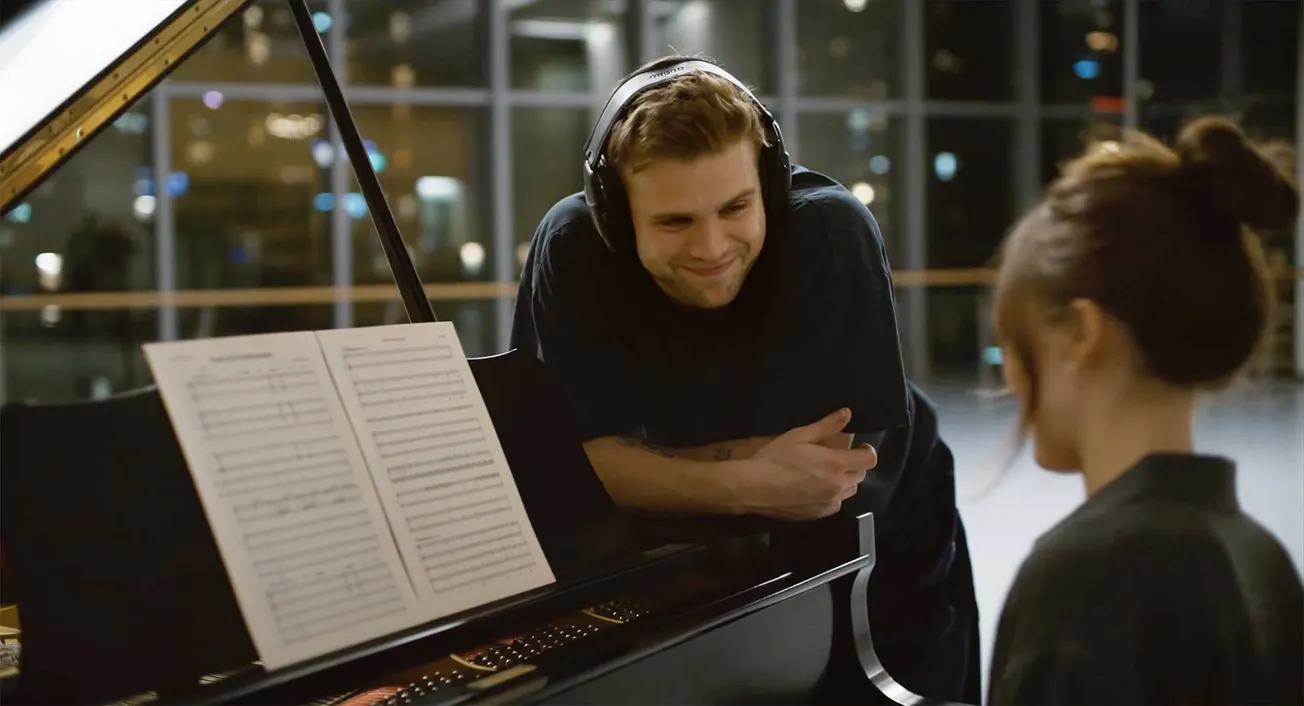
Set in modern times, the narrative takes us into the life of a young piano tuner, Niki (Leo Woodall), who initially seems interested in little beyond his makeshift family—led by his mentor, the tuner extraordinaire Harry (Dustin Hoffman)—and functioning well in the world with hyperacusis. This, you might wonder, is the sensitivity to sound. Having such travails, Niki wears protective earplugs or headphones at all times, lest he be pained or incapacitated by anything ranging from background noise to genuinely disruptive sonic events.
Early on in the film, Niki discovers that his disability can be used for financial gain through safe-cracking, though he is apparently not interested in the funds beyond their potential to help his family. This is complicated by his fledgling romance with a talented piano student, Ruthie (Havana Rose Liu), who knows nothing of his budding second life in the criminal underworld.
While music is central to the film, it is certainly built to appeal to various moviegoing crowds. Strong performances from Woodall and Liu (along with a striking turn from Lior Raz, playing the criminal mastermind Uri) help buoy the film in spite of fairly minimal character development. Little is said of the character’s backgrounds beyond Niki’s struggle with his ailment, and most of the film’s dramatic energy is funneled into his internal conflict and the chaos that ensues when his thieving goes awry.
It is hard to say what the lesson of the story is, beyond doing whatever it takes to help those in need. Additionally, one wonders how to interpret the fleetingly self-aware humor about immigrant stereotypes—which quickly morphs into full-on cartoon villainy from Uri and the film’s other antagonists, each of whom are minorities and apparently immigrants.
Niki is thus the link between the moral core of New York’s White male working class and those willing to cheat to get ahead, and even to get the girl. (Ruthie is the only female who sees any significant screen time.) That Niki eventually reneges on his commitment to crime, in the end his saving act is itself a continuation of dubious ethical reflection.
At least we are rewarded throughout with an excellent score from Will Bates (though it is not yet on streaming), and the consistent interpolation of real music during the story (from Marius de Vries) that helps guard the plot from too much audience reflection on more trivial matters, like philosophy, logic, or more efficient grand larceny.
Indeed, we are ultimately not meant to reflect on what makes for right or wrong in “Tuner,” or even what makes common sense. After all, we are asked to believe that Niki could easily get away with opening safes across the Big Apple’s upper crust without so much as an O. J. Simpson glove to cover his tracks (or fingerprints).
The film’s final twist is quite rewarding, though, if not somewhat predictable in its immediate prelude. And in the end, everyone but the bad guy wins, so to speak. It’s the perfect sort of symphony: One where even a few missed notes won’t be audible to the average audience member.
Nate Tinner-Williams is co-founder and editor of Black Catholic Messenger.