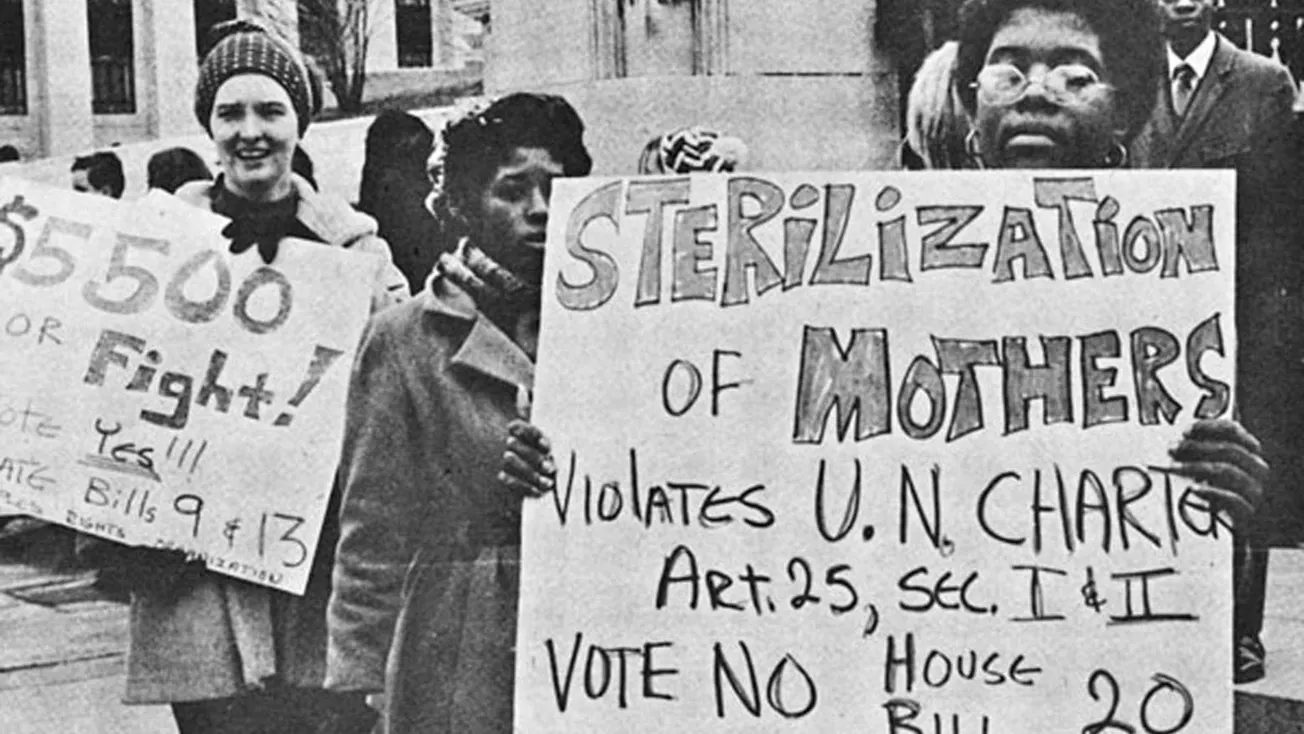
Over the last several years, several White pro-life individuals and organizations have made efforts to engage with the Black community and work side by side with them in the broader pro-life movement. Some pro-lifers have been successful, such as Mark Crutcher’s “Maafa 21,” a 2009 documentary on eugenics and forced sterilization against African Americans beginning in the era of slavery. The Live Action nonprofit has partnered with members of the National Black Pro-Life Coalition and included Black people in both their media and fellowship programs.
Other pro-lifers, however, have not been as willing. As a Black Catholic and someone passionately pro-life, I’ve observed both genuine desire and willingness to understand the Black community, and also intentional moves to create distance from it.
I’ve also seen the common skepticism that some White pro-lifers display towards the Black community and even the Civil Rights Movement, which undergirds Black public life. As a Black person observing the pro-life movement from within, I've witnessed how certain approaches can foster distrust and chip away at credibility. That being said, I believe there are some insights that can help bridge the gap.
Statistics aren’t everything
One of the most popular approaches that conservatives tend to take when engaging with the Black community is statistics-based. While statistics can help sort through raw data and identify underlying patterns in any given data set, they don’t provide a full picture of the intended group as a whole. Importantly, they can’t help us speak to each other relationally, person to person. In these instances, it can be easy for people to interpret certain statistics as brute fact, inveighing against a culture or institution as a whole.
This happens especially with religious polls conducted in certain restricted settings. For example, a poll on Catholics conducted at a university might ask a limited number of people for their religious preferences, and these data points are mistakenly conflated with the Catholic Church as a whole when interpreted by everyday readers.
Similarly, when it comes to the African-American community, specific disparities set within parameters of a study are often applied to African-American people as a whole—with our culture then blamed. One example is the statistics on fatherlessness. While it may be true that in specific data sets, Black homes tend to be led by single mothers, it would be reductionistic to assume this of all or even most Black people. It also disregards the reality of stable, present, and committed Black fathers.
This spills over into the pro-life movement, because its members tend to focus on fatherlessness in the Black community as a leading cause of the disproportionate abortion rate among African Americans. This also diminishes a vibrant Black culture full of its own history, traditions, and customs down to statistics. Can we realistically expect statistics alone to help bridge any gaps between White pro-lifers and Black community?
What most pro-lifers and conservatives in the public square don’t realize about the Black community is that it is largely relational and community based. We bond over shared experiences and struggles. Pro-lifers at least share this same unique bond over care for the human person, but the forest is often missed for the trees when the Black community is treated like a statistics manual that needs to be studied instead of people with relationships cultivated through trust and good will.
One clear example of this happened last September when conservative reporter and pro-lifer Cam Higby, who is White, went to Tennessee State University, an HBCU, with signs about DEI and mass deportations. What followed was Higby being swarmed in protest before campus security rushed him off the campus. Many assumed that TSU students were not open to discussion. What actually happened was a major miscommunication. Higby went to the campus to discuss cultural issues based on statistics, which the students immediately saw were antagonistic and fundamentally disruptive—as noted in a statement issued by TSU and the NAACP.
It isn’t bad to go into Black communities to have conversations, but will the pro-life movement learn how to do so genuinely and relationally?
Pro-lifers need civil rights wisdom
Another unfortunate but common pitfall for pro-lifers is advocating for an end to abortion while platforming people who disparage the Black freedom struggle they could be learning from. Some White conservatives, for example, have attempted to discredit the likes of Dr. Martin Luther King Jr. and Rosa Parks. One was Charlie Kirk, someone with whom I agreed on the inviolability of the unborn but who perpetuated many untruths about the Black community.
To be candid, I am asking White pro-lifers to have the courage to think freely for themselves about civil rights leaders and stop perpetuating lies that they have heard from other conservatives. Distance breeds myth, while encounter reveals reality. In other words, what I am finding is that the character of civil rights leaders is being assassinated by people who have never actually taken the time to read civil rights literature or jurisprudence.
Currently, the pro-life movement is experiencing a large rift between abolitionists and incrementalists, one major plank being the fact that many Republican politicians have backed off of using equal protection approaches to potentially ban abortion nationally. This is the same constitutional clause that was intended to guarantee human rights for African Americans following the Civil War. Instead of harnessing this tool, powerful pro-lifers are choosing to leave the issue of abortion to each state. This has caused frustration and tension around what pro-life strategy should look like moving forward.
Further, pro-lifers could be spending time learning the extremely effective protest strategies from the Civil Rights Movement, like the effectiveness of nonviolent resistance. Instead, some of the most prominent voices of the pro-life movement actively and publicly seek to undermine the Civil Rights Movement, instilling widespread skepticism about the history of Black activism more broadly.
Another source of wisdom comes in examining the pattern between the abolition of slavery and parallels now with abolishing abortion. Slavery was first federally overturned and given back to the states with the overturning of the Missouri Compromise in Dred Scott v Sandford. Many pro-lifers think that the fight to end abortion is over simply because the issue was turned back over to the states, but this is simply not true. Scott v. Sandford enshrined slavery and allowed it to proliferate. In the same way, the abortion rate has risen since Roe v. Wade was overturned.
The pro-life movement now finds itself in the Dred Scott stage. Abortions are not decreasing and the conservative strategy is not working. While slavery and abortion are not identical and it cannot be guaranteed that they will follow the same trajectory, they are both human rights issues and the patterns have been incredibly similar thus far. Accordingly, will pro-lifers come to understand they can actually gain insight from African Americans instead of collapsing them into statistics? Put another way, will they embrace the spirit of the Civil Rights Movement and learn from it, or will they continue to keep its wisdom at arm’s length? Only time will tell, and time may be running out.
Briana Jansky is a freelance writer, author, blogger, and Live Action North Star Fellow. She graduated summa cum laude with a B.A. in Philosophy. She is currently working toward an M.A. in theology and a certification in Health Care Ethics from the National Catholic Bioethics Center.


%3F)