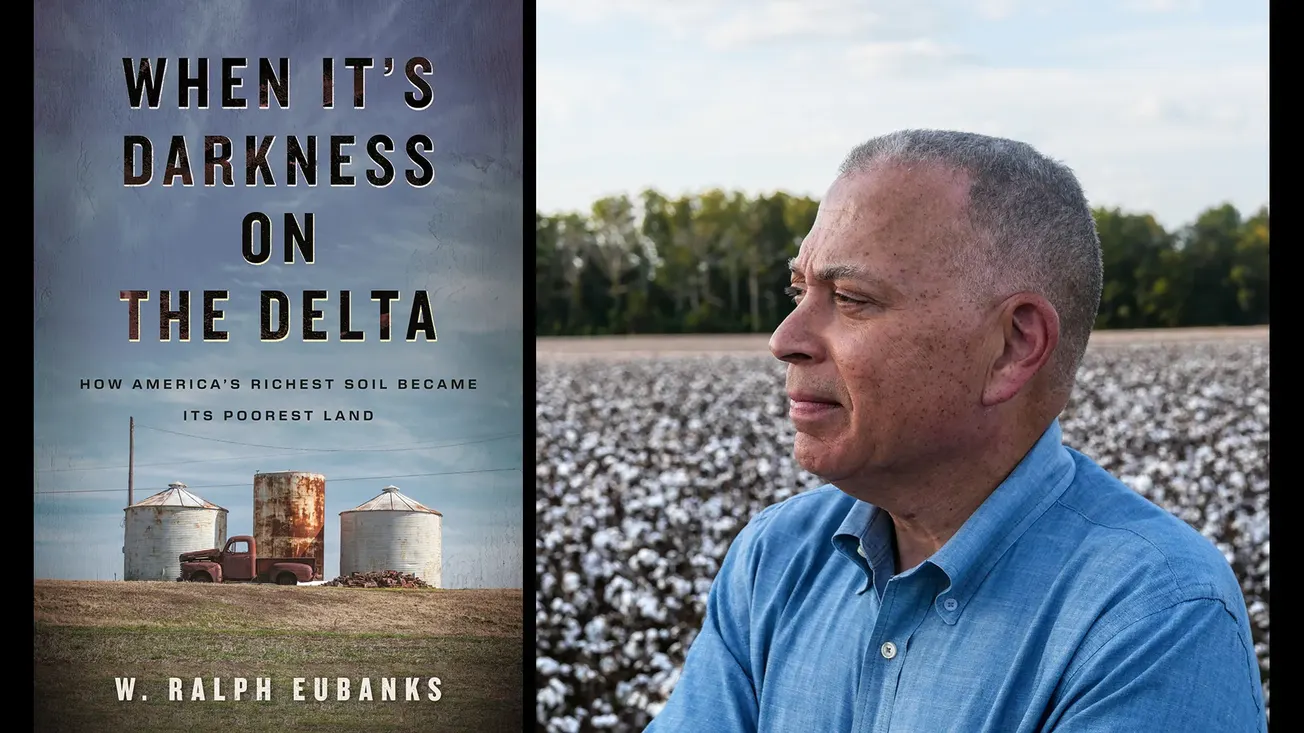
If there is a sentence from W. Ralph Eubanks’ “When It’s Darkness on the Delta: How America’s Richest Soil Became Its Poorest Land” that can encapsulate the book’s powerful message, it is this:
“I want us to begin to think about the Delta as the most American place on Earth.”
Part personal narrative and part travelogue, Eubanks’ newest work provides an illuminating look at the Delta region of his native Mississippi. He invites us to face—concretely—the myths, misunderstandings, and realities surrounding a region with a painful and layered legacy that played a critical role in powering the growth of the United States.
What’s more, he invites us to see how the experience of the Mississippi Delta is reflective of experiences across America and how reckoning can play a role in the road to a positive future.
Many may know of the region in terms of poverty, its legacy of racism and inequality, or as the birthplace of the blues. Introducing the reader to the Delta against the backdrop of his familial connections to the land, Eubanks documents his experiences traveling along its roads. Vividly accounting landscapes, histories, interaction with locals, and present realities of the area, he demonstrates how the area got to where it is and why—how its circumstances didn’t come out of nowhere and the measures being taken to move forward.
Eubanks goes on to connect the Delta to the larger American story as he compares the experience of the Delta to other areas of the country that face similar rates of economic and political inequality. He does this by using the example of the Appalachian region of Kentucky, travels to which he analyzes in “When It’s Darkness on the Delta.”
The reader is thus challenged to face what they think they know about the impact of inequality, exploitation, politics and race in our nation. The challenge is to see these things beyond a superficial construct and to grapple with tangible realities to envision a way forward.
That hit home for me as someone with familial roots in Mississippi and an interest in understanding how a place becomes what it is. As I haven’t had the chance to visit the Magnolia State, I felt a sense of being called to go beyond my passing understanding of the area while reading this book. Eubanks’ engaging approach to the subject and skillful writing was definitely useful in that respect. Also, as one who likes to approach subjects in full context, I found his connection of the region to the broader American experience added to the work’s resonance.
Myths and misunderstandings can surround a place, affecting how one thinks of and approaches it. In areas that have faced and continue to deal with structural inequality, this can especially be so. Eubanks deftly elucidates northwest Mississippi as one example in “When There’s Darkness in the Delta.” Beyond that, he guides the reader in going beyond said myths and seeing not just a particular region in America, but the story of America itself.
Rana Irby is a freelance writer from Detroit, focused on the intersections of faith and culture.