I’m on the train, about four hours into my trip to New York, when I remember Pierre Toussaint. He’s buried down in New York City, where I’ll be spending a couple of days for a birthday celebration. So, I guess this trip is a pilgrimage.
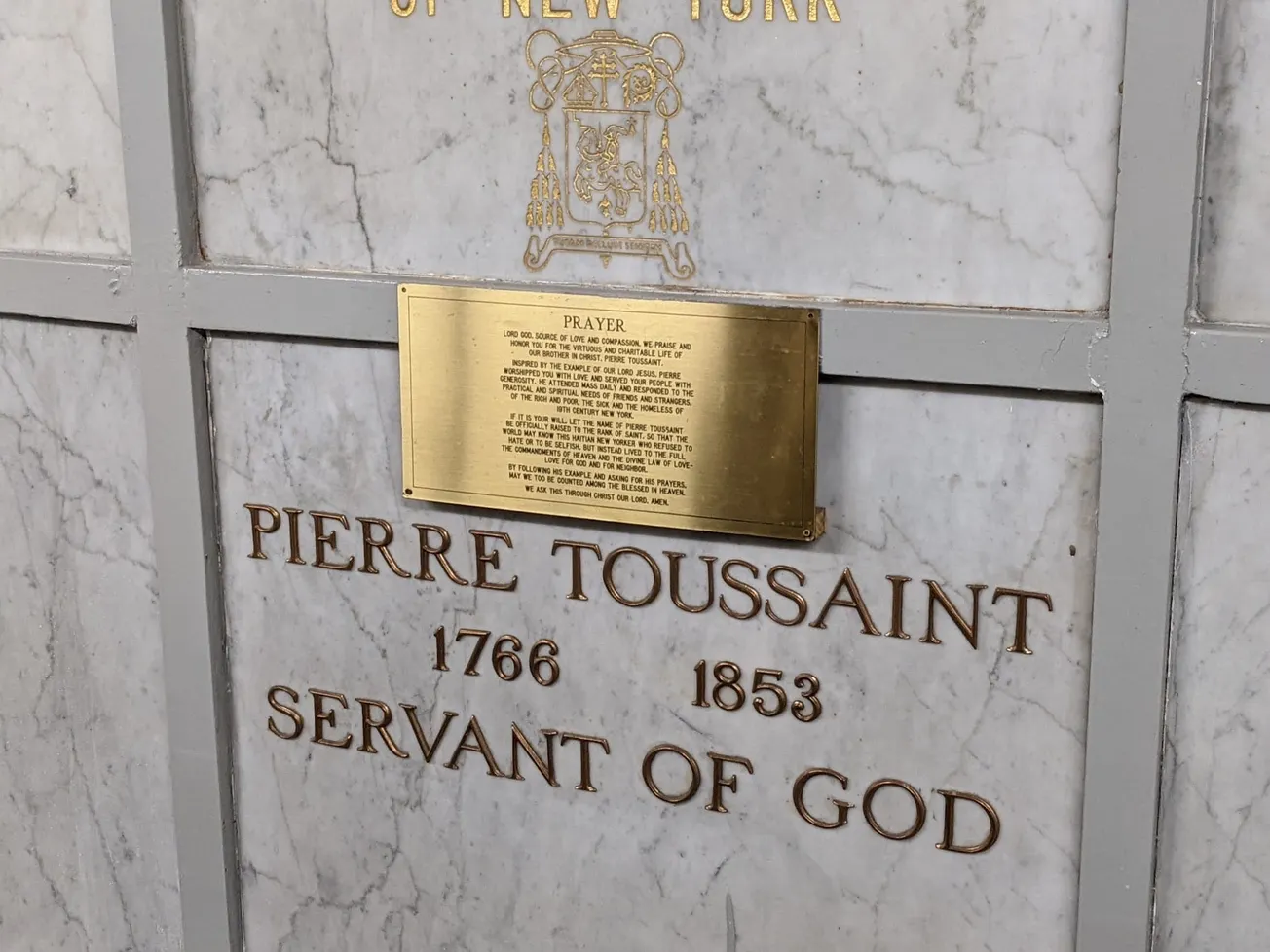
When I go to his tomb, the day is just starting, and even for a large city like New York, it feels like a quiet morning. There aren’t that many people in the cathedral, and most of them are there for the daily Mass in the Adoration chapel. Technically, I’ve never seen the tomb up close. In St. Patrick’s—a gothic marble building that is relatively short compared to the Midtown skyscrapers—Toussaint’s body is kept underneath the high altar, alongside the late archbishops of New York and other high-ranking clergy.
Toussaint, the only layperson buried there, was a formerly enslaved hairdresser for the New York elite. But as I knelt to pray at the crypt, I peered in. I could make out the name “Pierre.”
Toussaint’s story has fascinated me for a while, and not just because he is one of seven African-Americans up for canonization in the Catholic Church. Toussaint was a Haitian American, spending his life in the Caribbean and in New York, the latter during the early years of the United States.
He was born on a sugar plantation and brought to America with his fleeing owners, due to the rumblings of the Haitian Revolution. The historian Dr. Franklin W. Knight says the uprising was the first to overthrow a colonial force and establish a new state of entirely free citizens. It was the first sovereign state in the Caribbean and later became the second republic in all of the Americas. Toussaint was so close to freedom, but was instead taken to New York where his bondage continued.
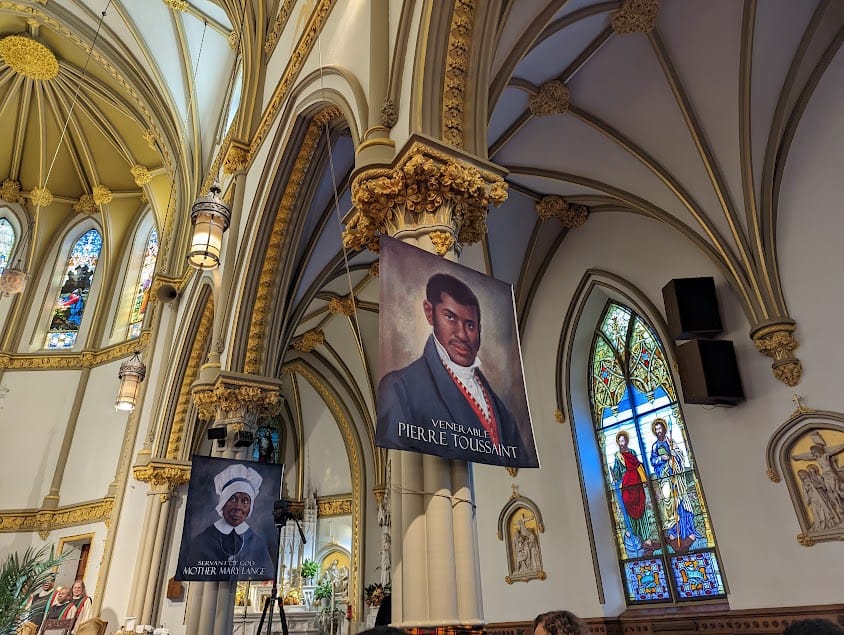
In the city, he found his own way as a hairdresser, doing French hairstyles for the rich and famous, such as Eliza Hamilton. This wasn’t just out of a desire to be the hottest hairdresser in Manhattan. It was also to support his owner, Madame Bérard, after her husband died. She eventually freed him, but only on her deathbed, 20 years after Toussaint’s arrival in America.
Reading through a memoir about his life and some modern accounts, I noticed that writers portray Toussaint as a happy-go-lucky slave, who made a lot of money and graciously served his master. I questioned if I were going to the shrine of the Catholic “Uncle Tom.” Was Toussaint really the best exemplar of holiness, especially for Black folks?
However, it seems Pierre was more strategic than I initially realized. Or, maybe I’m not giving him enough grace. Could he have exhibited the double consciousness described by W.E.B Du Bois, always being aware of his state as he interacted with the White folks around him? I mean, he was able to be in a position of influence, and even became a successful businessman and philanthropist. He helped finance Old St. Patrick’s Cathedral, and also paid for impoverished White Catholics to attend seminary. But he also advanced and fundraised for Black causes, purchasing his family’s freedom and donating to institutions helping African-American women and children in New York.
As Black people navigate historically White spaces, there is always a level of sacrifice. We watch our words and our actions carefully, smiling at microaggressions and patiently enduring ignorance. To some it can look like capitulation, but could it actually be one’s own form of resistance? To exist in spaces not made for you is a constant struggle and a constant cross. Here, in Venerable Pierre, is a man who maintained holiness in these spaces, being a light of Christ in a society that systemically oppressed him.
In the modern day, this oppression looks different, but can be found in the glaring silence of the Church or its alignment with movements that still devalue Black and brown bodies. In a world where Catholicism integrates itself more and more into American life, culture, and politics, Black experiences are ignored, and instead, a whitewashed version of the faith and our country persists. But sometimes presence in spite of this is a powerful witness.
After gaining his freedom, Pierre didn’t take the name of his master, the lady he dotingly served in slavery. Instead, he took the last name “Toussaint,” honoring the revolutionary leader of his homeland. Perhaps Pierre’s life was his own quiet revolution.
Tulio Huggins is a writer and theology graduate student. You can follow his writing on substack and instagram at @tulioisreading.