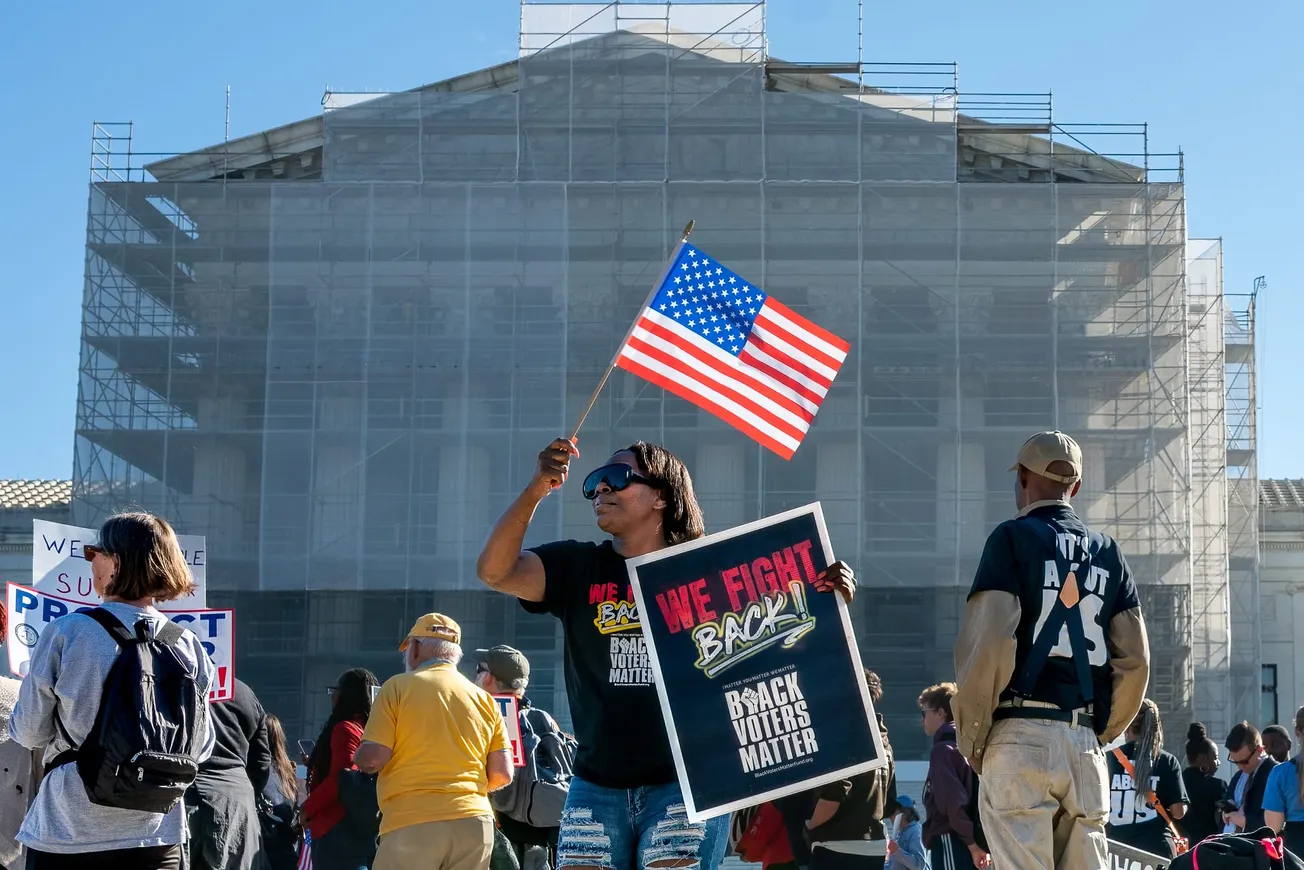
During the Civil Rights Movement, lawmakers and President Lyndon B. Johnson pushed to address the country’s deeply embedded racism and White Supremacy through social and political legislation. In his “Great Society” reforms, Johnson signed groundbreaking bills aimed at reversing racial injustice and expanding opportunity for Black Americans, including the Civil Rights Act of 1964 and the Voting Rights Act.
While there has been little legal contest to the former, the latter has been systematically dismantled and weakened over the years, creating barriers and disenfranchising Black voters across the country. These legal roadblocks are in direct opposition to the moral and spiritual vision of those that made a bloody sacrifice on the Edmund Pettus Bridge, and whose courage was the catalyst of the 20th-century federal voting rights protections.
On April 29, 2026, the U.S. Supreme Court’s conservative supermajority gutted Section 2 of the Voting Rights Act in Louisiana v. Callais, striking down Louisiana’s active congressional map in a 6-3 decision. The court found that the Republican-led state legislature’s creation of a second majority-Black district in 2024—the result of a lower court ruling that a previous map violated the Voting Rights Act—was an unconstitutional form of racial gerrymandering.
For many Black activists, leaders, and organizations dedicated to social and political progress, the intent of the high court is clear: to roll back long-fought for voting rights. Tragically, the decision will impact Black voters' access to expressing their political power.
Derrick Johnson, who serves as president and CEO of the NAACP, rebuked the Callais ruling in no uncertain terms:
“The Supreme Court betrayed Black voters, they betrayed America, and they betrayed our democracy.”
Today's decision is a devastating blow to what remains of the Voting Rights Act, and a license for corrupt politicians who want to rig the system by silencing entire communities. https://t.co/mbeo93k18V pic.twitter.com/Fa4WKsIOSp
— Derrick Johnson (@DerrickNAACP) April 29, 2026
The Congressional Black Caucus, the nation’s nonpartisan voice for Black Americans in Congress, issued its own statement on the court’s far-reaching decision:
“Without the protections of the VRA, Republicans now have the ability to move forward with a nationwide scheme… to manufacture more districts for themselves by eliminating majority-Black districts.”
This attack on voting and representation for Black Americans isn’t a sudden political tactic. It began after the historic Reconstruction Amendments in the 19th century, which outlawed slavery, granted citizenship to African Americans, and granted voting rights. These laws, in theory, created partial pathways to fundamental freedoms. However, since the passage of the 15th Amendment in particular—which prohibited race-based disenfranchisement—state and local governments have introduced various barriers, including poll taxes, literacy tests, and other forms of Jim Crow policies—all of which impeded Black voting power.
Therefore, a greater federal law had to be enacted to secure voting access. This was the Voting Rights Act of 1965.
Though many believe that the VRA guaranteed the vote for African Americans, a series of U.S. Supreme Court decisions have since narrowed the scope of its power. City of Mobile vs. Bolden (1980) and Shaw v. Reno (1993), for example, made it difficult to challenge voting systems and maps that weakened Black representation.
Shelby County v. Holder (2013), a massive assault on the VRA, removed the requirement that states with histories of voter discrimination get federal approval before changing voting policies. Since striking federal oversight in voting, an influx of restrictive bills and policies have impacted voters and complicated democracy.
The latest decision from the high court stands on the foundation of tinkering and removing sections of the VRA, a dismantling of its core concepts over time. Even as we are still processing Callais, Republican governors and lawmakers are already moving to gerrymander more aggressively. These swift movements only demonstrate how eager they are to eliminate Black political power.
Ultimately, this has created a generational experience of political struggle. Every generation of Black Americans have encountered hurdles to voting. These new threats by state legislatures in the aftermath of the Supreme Court ruling require immediate repudiation and taking a stand for Black racial justice.
The trend of high court rulings consistently reversing the VRA has only intensified with President Donald Trump’s appointments to the Supreme Court. He was able to nominate three conservatives to a lifetime appointment, cementing a powerful conservative majority intent on rolling back voting access.
Many of the justices embrace originalism, a legal interpretation that sees the U.S. Constitution as fixed in its meaning. In reviewing this philosophy, we know that it has excluded Black Americans from full participation in American freedom since the inception of the Constitution. Since the Court continues to diminish the reach of Black political power, this leaves many wondering: Can its highest court truly uphold civil rights?
It was Roger B. Taney, the first Catholic on the Supreme Court (and its first such chief justice), who left an atrocious stain on the courts with the Dred Scott v. Sanford decision, where he declared that Black people couldn’t be citizens and had none of the related rights. This dehumanizing ruling reinforced a racial hierarchy and furthered the oppression and subjugation of a class of citizens already at the bottom of the nation’s social standing.
It is true that Catholics like William J. Brennan Jr., a Supreme Court justice who served more than three decades, emerged as a liberal force that spearheaded civil rights rulings and legal protections in the 20th century. However, most of the Catholic justices appointed since his retirement in 1990 have been staunchly hostile to Black voting rights.
 Nate Tinner-Williams
In the wake of the Callais ruling, one thing noticeably missing is any response from the nation’s Catholic bishops. No acknowledgement from Archbishop Paul Coakley, the president of the U.S. Conference of Catholic Bishops, or any statements from high-ranking officials to urge action to protect voting came.
With more than a million Black Catholics living in the South, where Republican gerrymanders are being enacted as we speak, the Catholic witness for justice must be visible and vocal. Surely, Sr Mary Antona Ebo—the Black religious sister that marched in Selma, who proclaimed, “I’m here because I’m a Negro, a nun, a Catholic, and because I want to bear witness”—would chide the Church's inaction and remind them of justice and human dignity.
The ecclesiastical apathy continues the track record of powerful Catholics being indifferent to the needs of Black Catholics and Black Americans. When it’s time to rise up and showcase the power of Jesus to condemn the powers of evil that exist in systems of injustice and White Supremacy, the Catholic witness is far too often missing. The Church’s refusal to speak up consistently on matters impacting the Black community doesn’t convey a message of neutrality but instead reinforces injustice.
The bishops have addressed the importance of civic and political responsibility in what now feels like the long-distant past. In “Forming Consciences for Faithful Citizenship: A Call to Political Responsibility from the Catholic Bishops of the United States,” originally released in 2007, they affirmed the following:
“It is important for our society to continue to combat any unjust discrimination, whether based on race, religion, sex, ethnicity, disabling condition, or age, as these are grave injustices and affronts to human dignity.”
The boldness of this statement adds to the spiritual and moral imperative that the Church must adhere to in the present. Failure to heed their own words demonstrates an indifference toward Black Americans having their voting power systematically weakened by Republicans across the county.
Furthermore, basic themes of Catholic social teaching help us understand why a courageous witness is required. At the foundation, the dignity of the human person is the principle that all other themes revolve around.
If we attest that every human has sacredness and inherent worth by virtue of being a reflection of the Creator, then we must affirm that they have a right to life. If we uphold the importance of the preferential option of the poor and vulnerable, we have to recognize and accept that Black Americans have had a long history of being historically neglected, under-resourced, and powerless. Lastly, when we think about participation in society, if the systems and structures that are intended to be aimed for human flourishing are inefficient or place barriers to access, how can those most at-risk influence structures that directly impact their livelihood? If these precepts are neglected, the cycle of exclusion stands in contrast to the demands of Church teaching.
Far from being simply a macro-level issue, many White Catholics also need to understand the importance of the principle of solidarity. Politically, this starts with the implications of their voting and the responsibility to vote for the common good. The ballot box isn’t just an individual choice but a reflection of how government can function for everyone—the marginalized, the poor, and the historically neglected. The fight to organize and push back against injustice requires not just Black Americans but a united push from White Americans and others as well.
According to the data, White Catholics overwhelmingly vote for Republican presidential candidates, which can have an immense ripple effect on the judiciary and the potential to influence state and local decision-making. If the Church in America wants to be a moral witness against the forces of evil, addressing voter suppression and the disenfranchisement of Black Americans requires prophetic courage and willingness to align with the suffering of others.
These are not simply political issues, but a failure to adhere to a moral vision that recognizes the dignity of all. Black Americans have long fought to make this nation a beacon of light for democracy. Through the Civil Rights Movement and the martyrs who sacrificed their lives, we made America confront its failures and establish democracy not just as an aspiration but as a realized concept.
In this moment of continued assault on Black Americans and their civic responsibility, the enduring call of now is for widening hearts to embrace justice for all, protect human dignity, and assure the right to vote. If Black voting participation is weakened, the promissory note of justice and rights will only be a hollow promise—one that was apparently never intended for all but only for some.
Efran Menny is a husband, father, and regular contributor to BCM. His work is informed by his experience as an educator and his studies in social work. He has a passion for elevating topics on justice and theology for Black Catholics.