Black Canadian Studies scholars agree that people of African descent have resided in Canada for centuries. Although the practice of chattel slavery was abolished in 1834 throughout British North America (Canada), the attitudes and racial hostilities experienced by Black communities persisted. However, a Roman Catholic pastoral initiative in Windsor, Ontario, offered a notable exception. By highlighting this initiative, I seek to uncover the relationship between the Canadian Catholic Church and Black Canadians in the late 1800s. I argue that when actively engaged in the lives of Black Canadians, the Canadian Catholic Church creates an environment for evangelization and develops the capacity to proactively address the social, spiritual, and pastoral needs of Black Canadian Catholics.
Windsor held special significance in Black Canadian history given its close association with the Underground Railroad. Throughout the 1840s and 1850s, enslaved people fleeing chattel slavery in the United States found refuge in Canada. As they established communities, Windsor's Black population came to reflect a diverse mix of formerly enslaved and free people. One example of this community-building was the establishment of the historic First Street Baptist Church in Windsor in the 1840s. The church served not only as a house of worship but also as a hub of social support within Windsor's Black community.
Black Canadian Catholics, however, had a more precarious experience with the Catholic Church. Protestant communities were more actively engaged in the Black community, particularly through the abolitionist movement. During this period, Black Canadian Catholics can be described as a marginalized community struggling for recognition. However, Belgian priest Father Dean Wagner was attuned to the social and racial disparities affecting Black communities in Windsor.
Fr. Dean Wagner was the pastor of St. Alphonsus Church (1837–1896). Responding to his vocational call, Fr. Wagner embraced the words of Jesus: "When I was hungry, you fed me, when I was naked, you clothed me." His pastoral sensibilities led him to establish a mission and pastoral initiative specifically for the Black Canadian community. He was supported in this work by Bishop John Walsh (1867–1889), who encouraged neighboring Catholics to make donations.
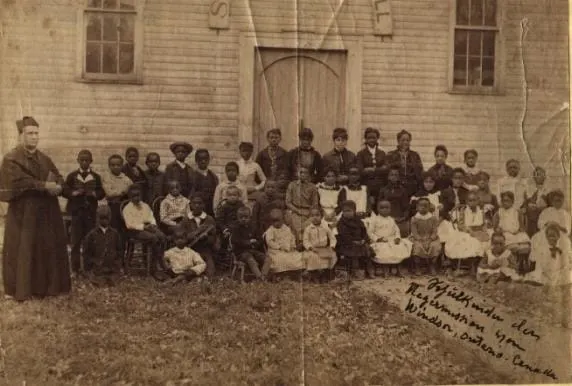
Fr. Wagner invited the Religious Hospitallers of St. Joseph (RHSJ) to oversee the mission's day-to-day operations. Subsequently, the Catholic Colored Mission of Windsor (1887–1893) became the first pastoral outreach initiative undertaken by the Canadian Roman Catholic Church in support of the Black community. The mission sought to provide pastoral care for Black Canadian Catholics and the wider Black Canadian community through the establishment of a day school, an orphanage, and, subsequently, a hospital. Given his efforts, Fr. Wagner may have been one of the contributing factors to the increased participation and presence of people of African descent within the Catholic Church during this period.
The effectiveness of the mission can perhaps be credited to its foundation in Catholic Social Teaching. At its heart was a recognition of the basic human dignity of Black people in Windsor. Fr. Wagner's pastoral care for Black Canadian communities stood in contrast to the prevailing attitudes of indifference within mainstream Canadian society and the Church.
Wagner was particularly passionate about the well-being of disadvantaged Black children. His genuine concern for their welfare, demonstrated through the establishment of a mission focused on African Canadians, also directly challenged the prevailing racial attitudes of the time. He recognized that establishing social institutions to support families in Windsor would benefit the entire community.
To support the mission, Fr. Wagner became an active fundraiser, traveling throughout Europe and Canada. He relied on the generosity of lay Catholics and other benefactors to sustain the mission. It is important to distinguish his persistent efforts from the limited support and tepid response he received from the institutional Canadian Catholic Church. Consequently, this period represented a missed opportunity for the wider Canadian Catholic Church to engage more deeply with the Black community and provide spiritual leadership in confronting anti-Black racism within both the Church and society. In many ways, Fr. Wagner was a historical actor ahead of his time.
Altogether, the mission raises difficult and critical questions: Why did the Canadian Catholic Church make so few attempts to establish similar missions or expand existing efforts? Did this level of disengagement from the Black Canadian experience contribute to the marginalization of Black Canadian Catholics within the Church? How has the Canadian Catholic Church been complicit in perpetuating societal attitudes of exclusion and marginalization toward Black Canadians, including Black Canadian Catholics? Moreover, how might the historical narrative have changed if the Church had responded more proactively to the devaluation of Black lives and the marginalization of Black people?
Today, a plaque commemorates the creation of the mission and Fr. Wagner's involvement. Its story reminds the Canadian Catholic Church that outreach to the Black community is both possible and fruitful when the Church meaningfully engages in the life of the community.
Nevertheless, the lives and contributions of Black Canadian Catholics have remained relatively hidden within the broader narrative of the Canadian Catholic Church. The history of the “Negro Mission” reminds us that Black Catholic history is not separate from the history of the Church, but an integral part of it. By uncovering these stories, one at a time, the Church can learn from its past and draw inspiration and wisdom as it moves forward in serving diverse communities and becoming a Church that is truly universal.
Tamika Royes holds a Master of Arts in Theological Studies from the Toronto School of Theology within the University of Toronto. She has several years of experience in the social services sector, public speaking, and as a workshop facilitator. In 2025, Tamika also completed a post-graduate diploma in Catholic Studies at Assumption University. She continues to write on issues of Black identity, life, and experiences within Canadian Catholicism.