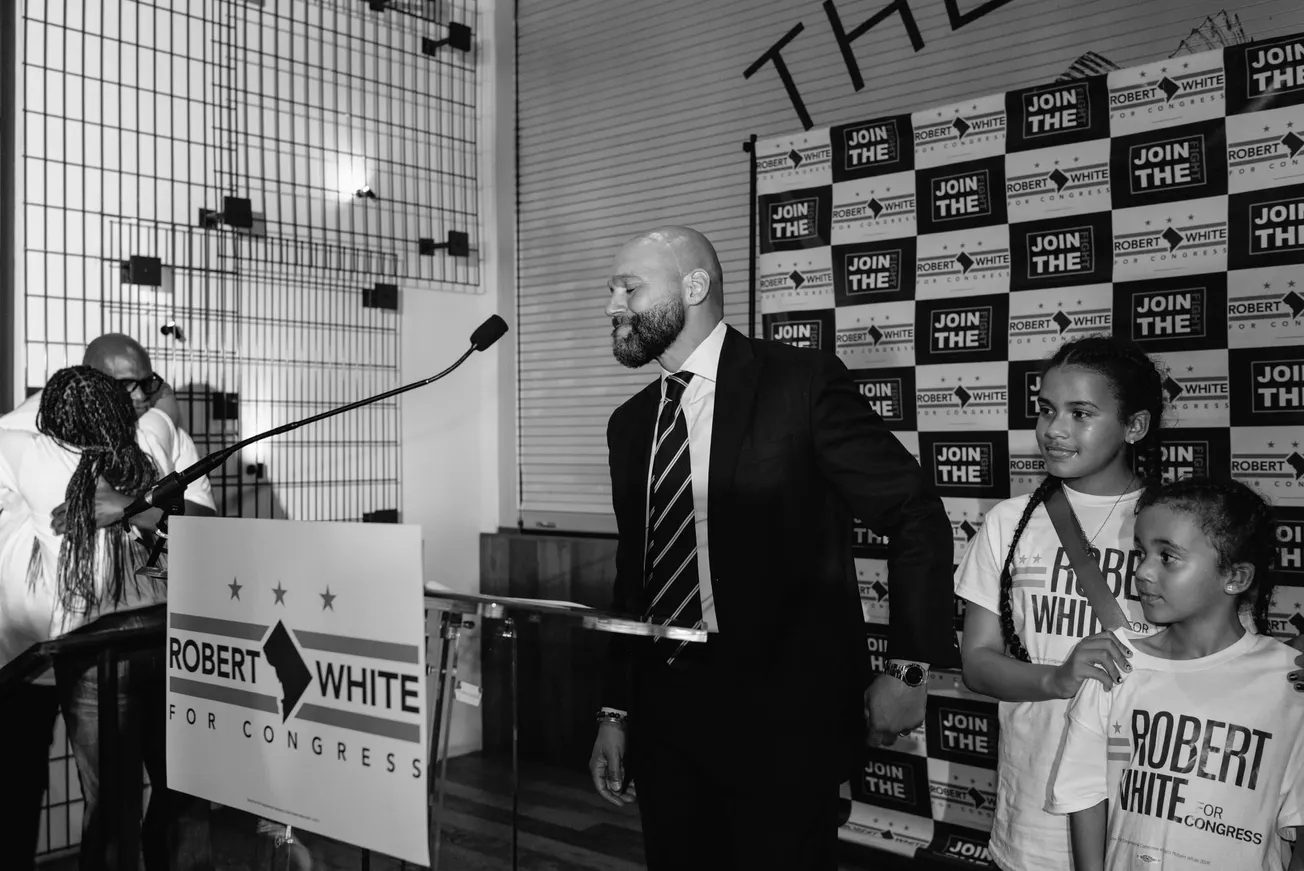
D.C. Councilmember Robert White Jr. has won the Democratic primary for Washington’s at-large district in the U.S. House of Representatives, setting him up to become the first new officeholder in 36 years. He defeated fellow councilmember Brooke Pinto, who outraised him by more than 3-to-1 in what became a highly contentious contest to succeed the retiring Del. Eleanor Holmes Norton.
White, a 44-year-old Black Catholic and fifth-generation Washingtonian who has been active in politics for nearly two decades, was the favorite to win the race for the non-voting delegate seat. He spoke of his landslide victory as the product of determination and as a call to action.
“If you knew the impossibility of my journey, of being here from where I started and what people expected of me—but that's a testimony for a different day,” he said in a video on Wednesday expressing thanks to voters, who elected him as his party’s nominee with nearly two-thirds of the vote.
“We will be so impacted by who gets elected in November, so this is time for us to pull together to mobilize. There's no one too young, no one too old, no one too successful or not successful enough. All of us, this is our time to dig in. This is our moment.”
D.C. delegate candidate Kinney Zalesne just released a statement congratulating Robert White on the win. She said she called him to concede and wish him luck. Notably, Pinto and Zalesne both raised more money than White, who earned a staggering 63% of the preliminary vote. pic.twitter.com/XJAjLbAbt3
— Emma Uber (@EmmaUber7) June 17, 2026
White’s victory all but secures his election this fall as D.C. delegate, a position held by Norton since 1991. White, an attorney who graduated from American University’s Washington College of Law in 2007, served as legislative counsel to her early in his career before becoming a D.C. Council candidate in 2013.
White was elected as an at-large councilmember in 2016, narrowly defeating incumbent Vincent Orange; he was then appointed to the seat after Orange resigned early from office. In 2022, he mounted a failed challenge to D.C. Mayor Muriel Bowser, finishing second in the Democratic primary.
In his campaign for Congress, announced in September as a challenge to Norton, White has emphasized his bona fides as a fighter for the working class and as the face of a new generation in District politics. He gained steam as Norton, now 89, faced scrutiny for seeking to retain her seat at an advanced age. She appeared increasingly frail in public appearances throughout the past year, while clashing with staffers over her stated intention to seek re-election.
After months of public back and forth and reports of alleged dementia symptoms, Norton announced in January that she would retire after 18 terms in office, opening the primary to a number of younger candidates, including White. His main challenger in the race was Pinto, a Caucasian councilmember who has served on the D.C. Council since 2020, representing Ward 2.
The ensuing race featured a number of controversies, including Pinto’s uploading of a 67-page dossier to her official website in April, revealing White’s home address, an image of his family home, and legal records concerning his relatives. The campaign ploy was derided by White as a flagrant example of “doxxing.”
Pinto apologized, but remained in the primary race despite White’s calls for her to drop out. On Tuesday, she congratulated him on his win, committing to supporting his general election campaign.
“[I] will do everything I can to ensure he—and our city—are successful,” she said.
“As this election season closes, let’s all remember we are on the same team in DC—we all have a responsibility to support the best interests of the District of Columbia.”
White, who advocates for D.C. statehood and opposes federal efforts to encroach on the district’s autonomy, will face Republican Denise Rosado and DC Statehood Green Party candidate Kymone Freeman in November.
White will be the heavy favorite for the safe blue delegate seat, and the general election will be the district's first to use ranked-choice voting. This system, approved by a ballot initiative in 2024, allows voters to rank their top choices and implements an instant runoff if no candidate initially receives a majority of votes. In the primary, White won with just over 63% of the vote in the first round.

Nate Tinner-Williams is co-founder and editor of Black Catholic Messenger.