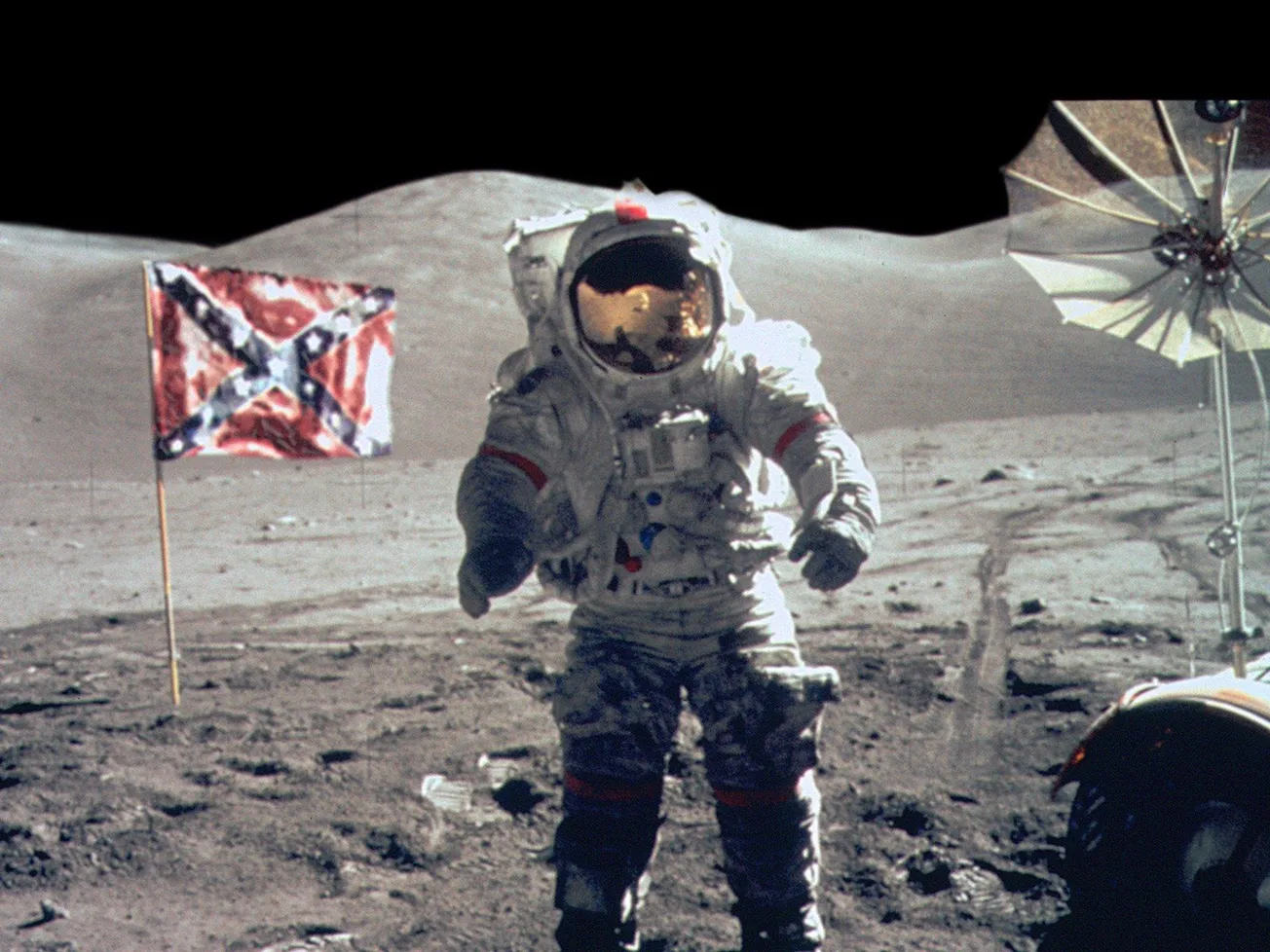
“Dear friends, the Colored is not ready for freedom. To free him is to make him an orphan. Liberty would be a great curse to the race.”
The line, delivered with chilling calm in “CSA: The Confederate States of America,” sounds like a relic of the 19th century—until the film reminds viewers it belongs to a nation that never lost the Civil War.
As the mockumentary reaches its 20th anniversary, its Academy Award-winning director Kevin Willmott says its imagining of a victorious Confederacy—resulting in an America where chattel slavery never ended—has aged from provocation into reckoning. Shaped in part by Willmott’s Catholic faith and its insistence on confronting injustice rather than looking away, “CSA” endures as a satire that refuses the comfort of distance.
It is noteworthy that Willmott didn’t inherit his Catholicism—he chose it, seeing the faith as a path toward truth rather than comfort.
“Being Catholic is kind of an intellectual faith,” Willmott said. “It’s smart, and it’s also challenging. It doesn’t make it easy. You have to put in a lot of individual effort to be a good Catholic.”
That effort for Willmott followed a pivotal moment in his youth before he went on to do films like “BlacKkKlansman,” “Chi-Raq,” and “Da 5 Bloods.” Expelled from high school for involvement in a 1975 race riot in Junction City, Kansas, Willmott took work mowing grass and helping at a local Catholic cemetery. There, he met Fr Frank Coady, a mentor who encouraged him to pursue college and filmmaking, and who introduced him to the moral framework of radical nonviolence.
“We talked movies,” Willmott recalled. “That friendship changed my life.”
Coady urged him toward Marymount College in Salina and introduced him to figures such as Dr. Martin Luther King Jr., Gandhi, Dorothy Day, and the Jesuit priest Daniel Berrigan—the latter of whom became Willmott’s pen pal. From these figures, Willmott absorbed a conviction that moral clarity requires confrontation, not avoidance.
“America has become such a violent society,” Willmott said. “We don’t even see nonviolence as a response as much as we should.”
A flag that bleeds
Willmott’s conviction collided with one particular symbol he couldn’t escape even in modern Kansas.
“I was very frustrated at the Confederate flag,” he said. “I’d see it on cars around town, even in Lawrence—this city that celebrates being [part of] a free state—and it just pissed me off.”
Pro-slavery militias had attacked Lawrence in years long past, during the era of “Bleeding Kansas” and during the Civil War, yet the flag of that cause still waved along Kansas streets and highways. The familiar defense followed: heritage, not hate. Willmott knew, however, that this “heritage” had long been a linguistic shield for racism—one that continues to reappear in modern politics.
“So I wanted to make a film that showed exactly what that ‘heritage’ really was,” Willmott said.
“It didn’t surprise me that the Heritage Foundation did Project 2025,” he added, referring to the far-right political framework associated with the second presidential campaign and administration of Donald Trump.
“That word has always been a red flag. People don’t know the history. They think something is a heritage when it’s really hate.”
Satire with teeth
To dismantle the Confederate mythology, Willmott turned to satire. “CSA” was intentionally rough-edged, styled like a historical documentary complete with fake commercials and archival footage.
“CSA really established me as a real filmmaker,” he said. “It solidified my ideas about history, America, and filmmaking.”
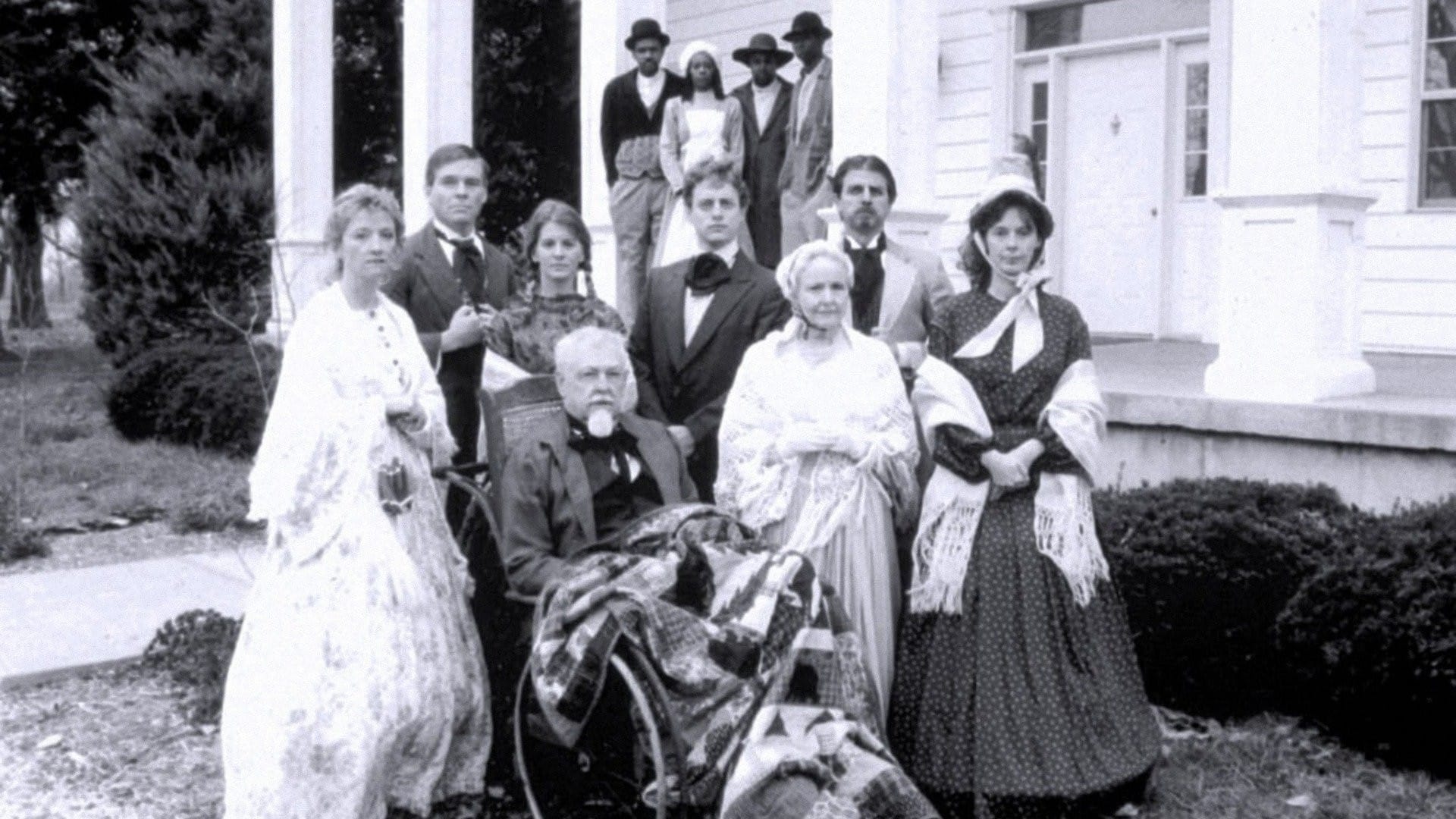
The film premiered at the Sundance Film Festival in 2004. Willmott, by then a professor, brought along University of Kansas film students who helped work on the production, many of whom slept on the floor of a rented condo while promoting the film. IFC Films acquired it days later and released it nationally in 2006.
“The film is how I met Spike Lee,” Willmott said. “It established me as a filmmaker with a point of view.”
That point of view was shared—and later articulated—by Dr. Novotny Lawrence, now a professor at Indiana University and director of its Black Film Center & Archive. He worked with Willmott while a graduate student at KU and appeared in “CSA,” including in a “slave-controlled drug commercial” and a runaway slave sequence.
“What would have happened had the South won? Kevin shows throughout the film that there are ways in which the South did win,” Lawrence said.
Ultimately, “CSA” argues that the legacy of slavery was never fully confronted. Lawrence believes that message has only grown more urgent.
“A lot of the things we’re dealing with right now all connect back to slavery—and the fact that we never fully reconciled with it in this country,” he said.
When the audience walks out
One important element in “CSA” is content that can create a continually escalating sense of discomfort for viewers. Willmott says this was not an accident.
“By the time you get to something like N***** Hair Cigarettes, nobody laughs anymore,” Willmott said. “That’s intentional.”
Audience reactions over the years have ranged from stunned silence to people leaving a screening altogether—something Willmott considers a success.
“I’ve seen people walk out all over the place,” he said. “Honestly, that’s the best compliment.”
One of Willmott’s friends reported that skinheads in Omaha, intrigued by the movie’s title, laughed through the first half of the film. They soon grew quiet and eventually left. Lawrence says he sees the same effect in classrooms today.
“CSA is hard-hitting without being preachy. It makes you uncomfortable, but it makes you think,” he said.
Willmott says his experience of watching audiences grapple with “CSA” eventually led him to a sobering realization.
“Seeing the film with audiences helped me understand how the South actually won the Civil War—not on the battlefield, but by holding onto their way of life,” he said. “Every election day, you see the two countries. The USA expands freedoms; the CSA limits them.”
Though officially retired from teaching, Willmott jokes that he still has “15 jobs.” One is completing “The Bard,” a film about George Moses Horton—the first Black man to publish a book in the South while still enslaved. Filmed in North Carolina in August, the project continues Willmott’s focus on art as resistance and truth-telling as moral duty.
For both Willmott and Dr. Lawrence, CSA remains a teaching tool—one that refuses to flatter its audience. Lawrence has even used the film in his classes at IU.
“CSA is asking people to feel something, sit with it, and then ask: Why do I feel this way—and what am I going to do about it?” Lawrence said.
Twenty years later, the question still lingers. How different are we, really, from the world Kevin Willmott imagined? The answer is unsettling.
Matt Memrick is a North Carolina-based journalist with 25 years of newspaper, TV and digital experience. A graduate of Belmont Abbey College, he currently works as a freelance writer for QCityMetro.com and writes about diversity issues with an unofficial alumni group called Conscious Alumni of BAC. His blog is at consciousalumniofbac.substack.com.