
Clarence B. Jones, the Black Catholic activist who helped write famous speeches for Dr. Martin Luther King Jr.—including his landmark “I Have a Dream” text—has died in California. No cause of death was announced and he was 95 years old.
His family announced the news on May 25, three days after his death, and spoke of him as an enduring figure who “lived a life of conscience.”
“He believed, until his final days, that an idea whose time has come is more powerful than the march of any army. We are grateful beyond words for the love, the prayers, and the friendships that sustained him, and us, across this long and remarkable life.”
An esteemed, beloved elder is now an ancestor.
— The Martin Luther King, Jr. Center (@TheKingCenter) May 25, 2026
Clarence B. Jones, among Dr. King’s trusted legal counsels and strategic advisors, has passed.
We are grateful for his life and his work in the interest of justice and Civil Rights.
Our hearts go out to his family and our… pic.twitter.com/lm4xYWbLhp
Born in 1931 in Philadelphia to Goldsborough Benjamin and Mary Elizabeth Jones, Jones was raised in a foster home in his early years due to his parents’ live-in work arrangements. He attended the Holy Providence House boarding school run by St. Katharine Drexel’s Sisters of the Blessed Sacrament in Bensalem, where he was baptized into the Catholic faith and served as an altar boy, before later reuniting with his family in New Jersey. His mother had also been raised partially in an SBS convent school.
After graduating as valedictorian from a public high school, Jones was drafted into the Korean War but discharged after just under two years, in 1955, over his left-wing politics during the highly charged McCarthy era. He went on to graduate from Columbia University and the Boston University School of Law and commenced practicing entertainment law in California in the late 1950s.
Jones first met King in 1960, being invited by the emerging civil rights scion to join his team of activists seeking an end to nationwide discrimination against African Americans. Another Catholic-raised Black advocate, Harry Belafonte, was instrumental in recommending Jones for the legal team of King’s Southern Christian Leadership Conference, leading to Jones’ move from the West Coast to the SCLC’s Harlem office.
“It wasn't only that Clarence put social justice ahead of making money,” Belafonte once said. “He always had the right word to raise the house spirits.”
After winning a high-profile tax fraud case for King in 1960, Jones helped smuggle what became the seminal “Letter from a Birmingham Jail” out of King’s solitary confinement cell in Alabama, in the wake of his 1963 arrest during a nonviolent resistance march. The manuscript would help galvanize a multiracial coalition in support of the Civil Rights Movement, challenging White moderates, especially Christians and Jews, to join future protests.
Later that year, Jones was a core organizer for the March on Washington, where King delivered his “I Have a Dream” speech to a crowd of more than 250,000 on the steps of the Lincoln Memorial. Jones had helped write the beginning paragraphs of text, including comments comparing the founding documents of the United States to a “promissory note” that had “bounced” for African Americans. Afterward, Jones assisted in protecting King’s copyright privileges to his most famous speech.
Also in the 1960s, Jones helped defend the movement against a libel lawsuit from Montgomery Public Safety Commissioner L.B. Sullivan, who claimed that a group of ministers had defamed him with an ad in The New York Times criticizing the violent police response to a 1960 protest in Alabama’s capital. While a state jury awarded Sullivan damages equivalent to more than $5 million, Jones led a team of attorneys in successfully arguing before the U.S. Supreme Court that the ad was within the realm of free speech, resulting in the watershed 1964 decision New York Times Co. v. Sullivan.
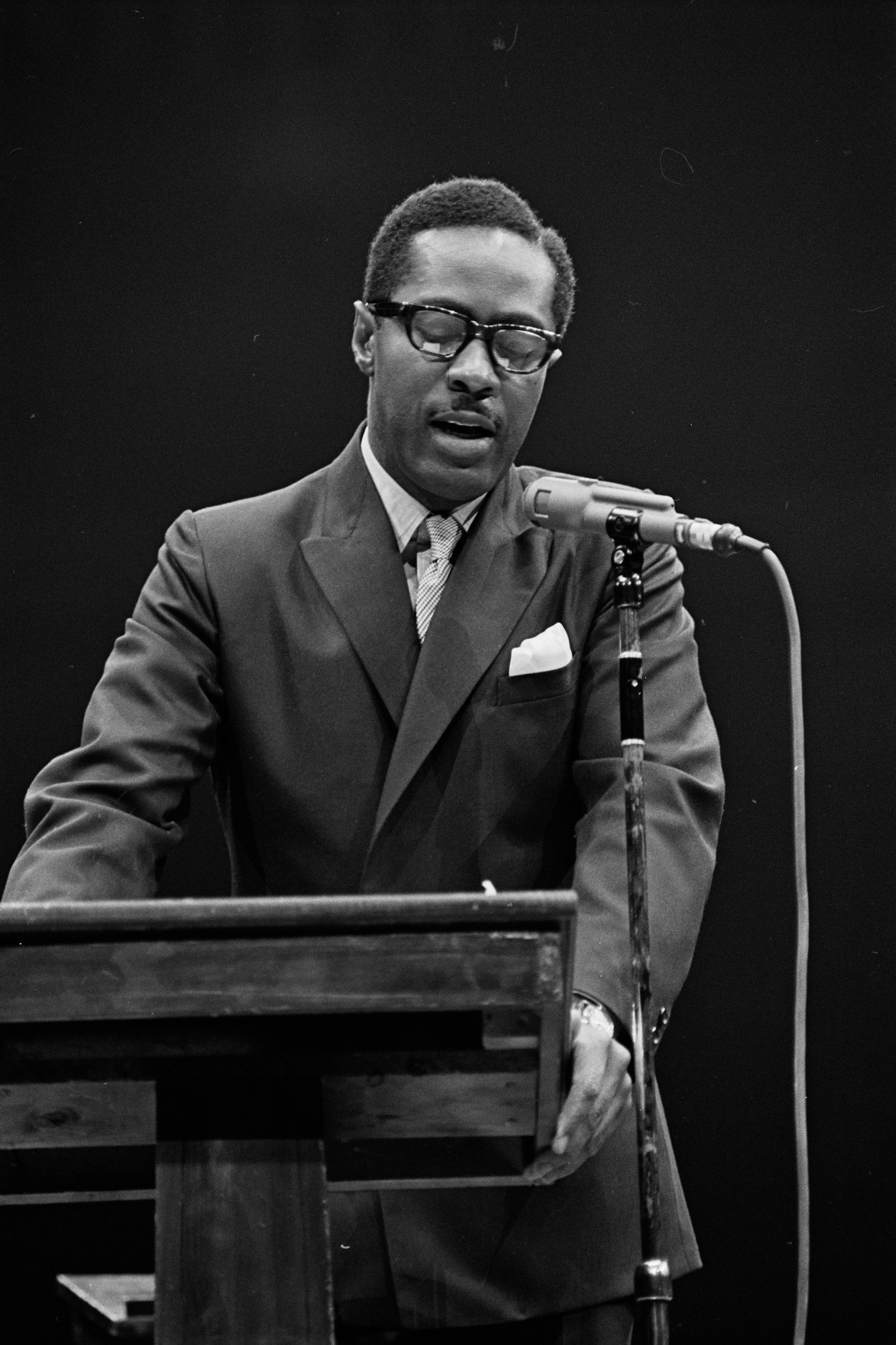
In King’s later years, Jones helped draft the anti-war speech “Beyond Vietnam: A Time to Break Silence,” reflecting the minister’s shift to broader social justice issues plaguing America and the world in the late 20th century. King was killed a year later, portending the end of Jones’ service in the SCLC.
“As a brilliant legal mind and courageous organizer, he helped defend civil rights leaders, raise support for SCLC, and protect the movement during one of the most important chapters in American history,” the organization said in a statement.
“His work strengthened the fight for justice, equality, freedom of the press, and human dignity.”
Jones commenced a career in finance beginning in the late 1960s, joining the investment firm Carter, Berlind & Weill and becoming the first African-American allied member of the New York Stock Exchange in 1967 at the age of 36. A respected community figure, in 1971 he was requested by inmates to serve as a mediator during the deadly Attica Prison Riot in New York, and he also became a part-owner of the New York Amsterdam News, one of the nation’s oldest Black newspapers. He departed the media outlet in 1974.
A 1982 fraud case of his own ended Jones’ banking career, after which he became a consultant, a prominent member of nonprofit boards, and an academic. He joined Stanford University's Martin Luther King Jr. Research and Education Institute in 2006, helping to cement the historical footprint of the SCLC and the broader Civil Rights Movement.
Jones joined the faculty of the Jesuits’ University of San Francisco in 2012, teaching law and politics. He founded the Institute for Nonviolence and Social Justice in 2018, passing on the principles of nonviolence and social change to undergraduates in the final years of his life.
 Nate Tinner-Williams
Jones was the author or co-author of several books following his move to California, including “What Would Martin Say?” (2008), “Behind the Dream: The Making of the Speech that Transformed a Nation” and “Uprising: Understanding Attica, Revolution, and the Incarceration State” (2011), as well as his 2023 memoir “Last of the Lions.” A documentary short on his life, “The Baddest Speechwriter of All,” premiered at the Sundance Film Festival earlier this year, earning the Short Film Grand Jury Prize.
Jones received several honorary doctorates over his more than six-decade career including from Lincoln University (Pennsylvania) in 1994, Drew University in 1999, Allegheny College in 2004, and USF in 2012. He was recognized at the White House by Barack Obama in 2015 for his contributions to the Civil Rights Movement, and his high school alma mater, Palmyra High School in New Jersey, established the Dr. Clarence B. Jones Institute for Social Advocacy in 2017.
He received the National Education Association’s President’s Award in 2021 for his leadership in the academy, and the Thurgood Marshall Award the same year from the American Bar Association. He was honored with the American Lawyer Industry Lifetime Achievement Award in 2022, and received the Presidential Medal of Freedom from Joe Biden in 2024.
Jones was a resident at an assisted living facility in Cupertino, California, at the time of his death and was surrounded by family at his passing. He is survived by his children Christine, Alexia, Clarence “Ben” Jr., Dana, and Felicia, and his longtime partner, Lin Walters.
A private memorial service will be held with family members at Eden Cemetery in Collingdale, Pennsylvania, and a public memorial service is expected to be held in New York this fall. Details will be posted to cbjonesmemorial.com. The family asks that in lieu of flowers, donations be made to the Dr. Clarence B. Jones Institute for Social Advocacy.
Nate Tinner-Williams is co-founder and editor of Black Catholic Messenger.