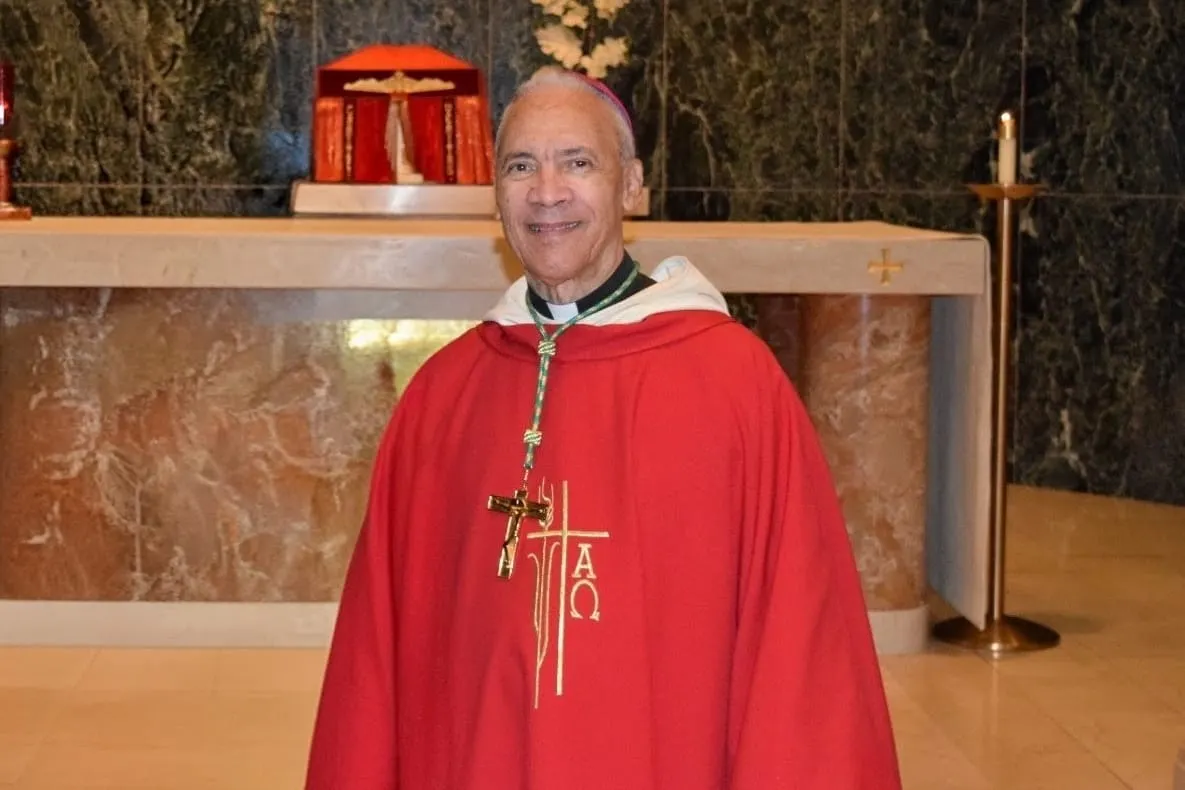
Bishop John Ricard, a Josephite who served as the first Black Catholic prelate in Florida history, died this month in Washington. He was 86 years old.
His religious community announced the news of his death, which occurred on May 20. He had been hospitalized in declining health prior to his death at St. Joseph Seminary in Washington.
“A devoted shepherd, missionary, educator, humanitarian, advocate for justice, and faithful servant of the Gospel, Bishop Ricard dedicated his life to proclaiming Christ and serving the people of God,” reads an obituary from the Josephites, “especially within Black Catholic communities and among those suffering throughout the world.”
With faith in the resurrection and deep gratitude for a life devoted to God and His Church, the Roman Catholic Diocese of Pensacola-Tallahassee and the Society of St. Joseph’s of the Sacred Heart mourn the passing of Most Reverend John H. Ricard, SSJ, who entered eternal life on… pic.twitter.com/2c9bZt7P3E
— The Society of St Joseph of the Sacred Heart (@TheJosephites) May 26, 2026
Born Sam Huston Ricard in 1940 to Maceo and Albanie St. Amant Ricard in Pointe Coupee Parish, Louisiana, Ricard was raised in the Catholic faith as part of a large Black Creole family, including several relatives who would enter the priesthood or religious life. These include two cousins, Archbishop Shelton Fabre of Louisville and Fr Tony Ricard of New Orleans. Bishop Ricard moved to Baton Rouge with his family while still an infant and grew up in segregated environs in Louisiana.
After completing high school in 1958, Bishop Ricard entered the Josephites, a historic religious community dedicated to serving African Americans since 1893. He professed final vows in 1967 and was ordained to the priesthood in 1968 after studies at Epiphany Apostolic College in New York and St. Joseph’s Seminary. He later earned a master’s in sociology at Tulane University and a doctorate in social work at the Catholic University of America. He also studied at the Washington School of Psychiatry,
A trained psychotherapist and psychoanalyst, Ricard’s dissertation concerned clinical depression among women, and he served for a time as a professor at CUA and at Tulane. His work as a minister included parish work in the Black communities of Washington and New Orleans until his appointment to the episcopate, and has also served as consultor general for the Josephites from 1978 to 1981.
In 1984, Ricard was named an Auxiliary Bishop of Baltimore, becoming one of the “First 10” openly Black Catholic bishops in U.S. history and the first in the Baltimore Archdiocese. His early tenure included an outsize impact on the development of African-American ministry in the Church, including the revival of the Colored Catholic Congress movement in the form of the National Black Catholic Congress in 1987. He would serve as NBCC president for 32 years.
“Bishop Ricard dedicated his life to faith, justice, and the strengthening of our Church community,” said Auxiliary Bishop Emeritus Roy E. Campbell Jr. of Washington, Ricard’s successor at the NBCC.
“His wisdom and unwavering commitment to the mission of the Gospel touched countless lives across the nation.”
Sharing the news of the passing of Bishop John H. Ricard, SSJ https://t.co/TFxGw6egig #RIPBishopRicard #BishopJohnHRicardSSJ pic.twitter.com/8XToYJOYUg
— The National Black Catholic Congress (@NBCCongress) May 21, 2026
Remaining in residence at a Josephite parish during his time in Baltimore, Ricard served as urban vicar for the archdiocese and was a familiar sight in the city’s inner city, having explicitly dedicated himself to the issues facing African Americans in the late 20th century. The same year he became a bishop, he and the nation’s other Black Catholic bishops issued the landmark pastoral letter “What We Have Seen and Heard,” encouraging pride in Black spirituality and championing African-American presence in the larger Church.
In 1997, Ricard was appointed Bishop of Pensacola-Tallahassee, becoming the first (and to date, only) Black Catholic bishop in Florida history. He remained there for 14 years, overseeing educational expansion, chancery enhancements, and guiding the growth of the diocese during a surge in membership. He was also instrumental in the region's recovery after the ravages of Hurricane Ivan in 2004, helping to coordinate regional relief efforts.
During his nearly three decades as a bishop, Ricard served as chair of Catholic Relief Services from 1995 2002, chair of the U.S. Conference of Catholic Bishops’ Committee on Social Development and World Peace from 19992 to 1995, chair of the USCCB Committee on International Justice and Peace from 2002 to 2005, and as a member of the USCCB’s Subcommittee on African American Affairs. He also helped found the USCCB’s Subcommittee on the Church in Africa in 2006.
In 2009, Ricard suffered a stroke, requiring extended hospitalization and intensive physical therapy. He returned to limited diocesan work in 2010 but continued to face health issues, ultimately retiring early from the episcopate in 2011 at the age of 71.
The same year, Ricard began service as rector of St. Joseph Seminary in Washington, coordinating formation for Josephite seminarians while continuing to lead the NBCC. He was also appointed to a USCCB special task force in 2016 to address national racial tensions in the wake of civilian and police shootings in 2016. He also continued to be a prominent voice on issues of racism, poverty, and pacifism.
We are deeply saddened by the death of Bishop John Ricard, SSJ, who was a pastor in @WashArchdiocese & then auxiliary bishop of @archbalt. May he rest peacefully with the Lord. https://t.co/7nVtSY3srT
— Maryland Catholic Conference (@mdcatholic) May 22, 2026
In 2019, at the age of 79, Ricard was elected superior general of the Josephites, becoming just the third Black member to hold the post. Thereafter, he retired as president of the NBCC and was reelected as Josephite superior in 2023. In his final years, he also served as a consultant to the USCCB’s Ad Hoc Committee Against Racism, then headed by his cousin, Bishop (later Archbishop) Shelton Fabre.
“In addition to the sadness I feel as a relative, I must admit that I am grieving the loss of another African American bishop of the Catholic Church,” Fabre said following Ricard’s death.
“Together with my family, the Josephite Fathers and Brothers, my brother bishops, the faithful of the Diocese of Pensacola-Tallahassee, the Knights of Peter Claver, and so many who have dedicated their efforts to serving the needs of the Church, I praise God in thanksgiving for the ministry of our dear brother.”
While serving as Josephite superior, Ricard split time between the Josephite motherhouse in Baltimore and the seminary in Washington, and faced intermittent health issues. He reportedly suffered a fall in his final weeks and ultimately succumbed to his injuries. His obituary did not list survivors.
A visitation for Ricard has been scheduled for Monday, June 1 at Our Lady of Perpetual Help Catholic Church in Washington, beginning at 10am ET. A funeral Mass will follow at 11am. A second visitation will take place on Friday, June 5, at the Cathedral of the Sacred Heart in Pensacola, Florida, at 10am, followed by a funeral at 11am. The ceremonies in both Washington and Florida will be livestreamed. Burial will be at St. Michael’s Cemetery.
Donations in Ricard’s honor can be made to the Josephites online or by mail to P.O. Box 65010, Baltimore, Maryland, 21209.
Nate Tinner-Williams is co-founder and editor of Black Catholic Messenger.