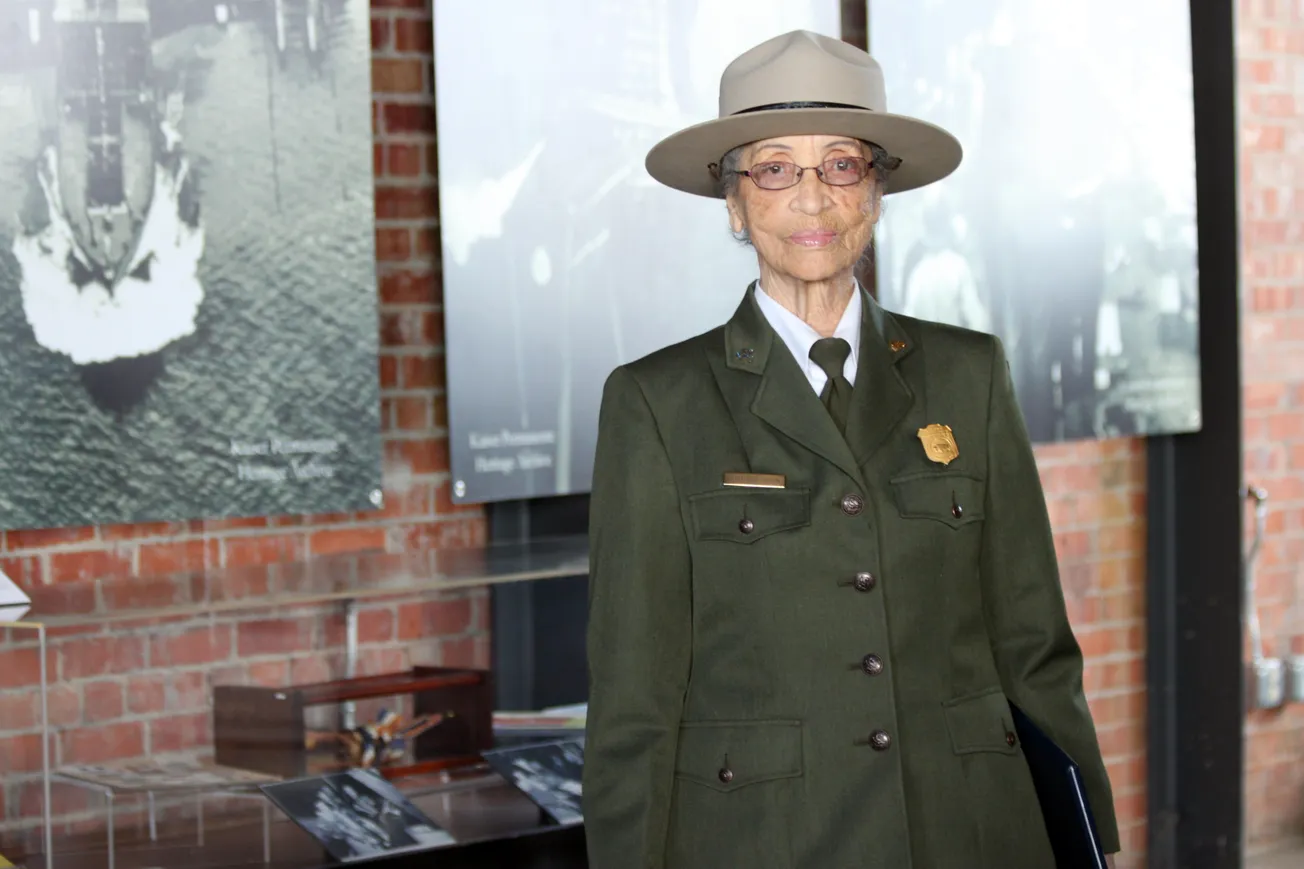
Betty Reid Soskin, the famed Black park ranger who served into her centenarian years before retiring in 2022, was remembered this month at a public memorial service in her native California. She died at age 104 in December.
Her family led the ceremony, attended by roughly a thousand mourners, on March 1 at the Henry J. Kaiser Center for the Arts in Oakland.
“Her death was an accomplishment. My mother wanted to be gone for a while. She wanted to go, she was ready to go, and she went,” said her son Robert “Bob” Reid, who both memorialized his mother and performed music in her memory during the livestreamed service.
“My mother [squeezed] out all the life there was in that body.”
More than 1,000 people gathered in #Oakland, Ca., on Sunday, March 1, 2026, to honor the life of Betty Reid Soskin, the nation’s oldest serving @NatlParkService ranger, who died in December at age 104: https://t.co/VfP5jmUmHy #BettyReidSoskin #RememberHonorUnderstand pic.twitter.com/HZIIiiSz2D
— Pacific Historic Parks (@pacificparks) March 2, 2026
Born in 1921 in Detroit, Soskin (née Charbonnet) was descended from Louisiana Black Creoles and was raised in the Catholic faith. She moved to New Orleans in her earliest years and to Oakland after the Great Mississippi Flood of 1927.
In 1945, Soskin founded with her first husband Reid’s Records in Berkeley, which sold mainly gospel records. The couple also integrated the White suburb of Walnut Creek, facing various forms of violence from the local community. A musician in her own right, Soskin contributed her songwriting skills to the Civil Rights Movement, including the 1964 song “Your Hand In Mine,” honoring the Mississippi activist Fannie Lou Hamer.
Following her divorce from Mel Reid in the 1970s and a decline in his health, Soskin became the sole manager of Reid’s Records, which continued to flourish as a center of Black culture in Berkeley. Soskin was also an active civic figure, raising funds for the Black Panther Party and partnering with the social justice work of the Unitarian Universalist Association after her conversion. She passed ownership of Reid's Records to her daughter in 1990.
Soskin was an integral point person in efforts to memorialize the role of women and African Americans stateside during World War II, having herself worked at a local boilermaker union during the conflict. With her help, the National Park Service opened the Rosie the Riveter World War II Home Front National Historical Park in Richmond, California, in 2000.
“My mother had an ability to introduce difficult topics in a way that people were able to hear them,” said Bob Reid during her memorial this week.
“Because she was an older person, she wasn’t as threatening as a younger person might be. She was so energetic. She was like a young person in an old person’s body.”
After many years of working on staff with state and local politicians, Soskin joined the NPS as a consultant in 2003, before becoming a park ranger at the age of 85. She worked at the park she previously helped create, curating programs and tours shining a light on hidden histories related to the war effort. She was originally a temporary ranger but eventually became a permanent employee, remaining on staff until her retirement at the age of 100.
Soskin received numerous honors during her career, including being named a California Woman of the Year by the state legislature in 1995. After becoming a national figure of note during her time as a park ranger, Soskin was invited to the National Christmas Tree Lighting by President Barack Obama in 2015, and received a commemorative presidential coin. She was also honored on three occasions by Congress, and received a Silver Service Medallion from the National WWII Museum in 2016. A middle school in El Sobrante, California, was renamed in her honor in 2021.
Soskin released her memoir, “Sign My Name to Freedom,” in 2018 to rave reviews, and a musical of the same name (and featuring her music) premiered in San Francisco in 2024. A documentary on her life began production in 2016.
Soskin suffered a stroke while working at the park in 2019 and returned to limited work shortly before the onset of the COVID-19 pandemic. She died at her home on Dec. 21, 2025, after a period of declining health.
Soskin was predeceased by her parents, Dorson Louis and Lottie Charbonnet; her siblings, Marjorie Charbonnet Brooms and Lottie C. Fields; ex-husband, Mel Reid; her second husband, Dr. William “Bill” Soskin; and two children, Dale Richard “Rick” and David Allen Reid. She is survived by her son, Bob Reid; daughters, Dorian and Diara Reid; five grandchildren; and one great-grandchild.
Her family has asked that donations be made in her memory to Betty Reid Soskin Middle School or to the “Sign My Name to Freedom” documentary's production efforts, which are ongoing.
Nate Tinner-Williams is co-founder and editor of Black Catholic Messenger.




.jpg)