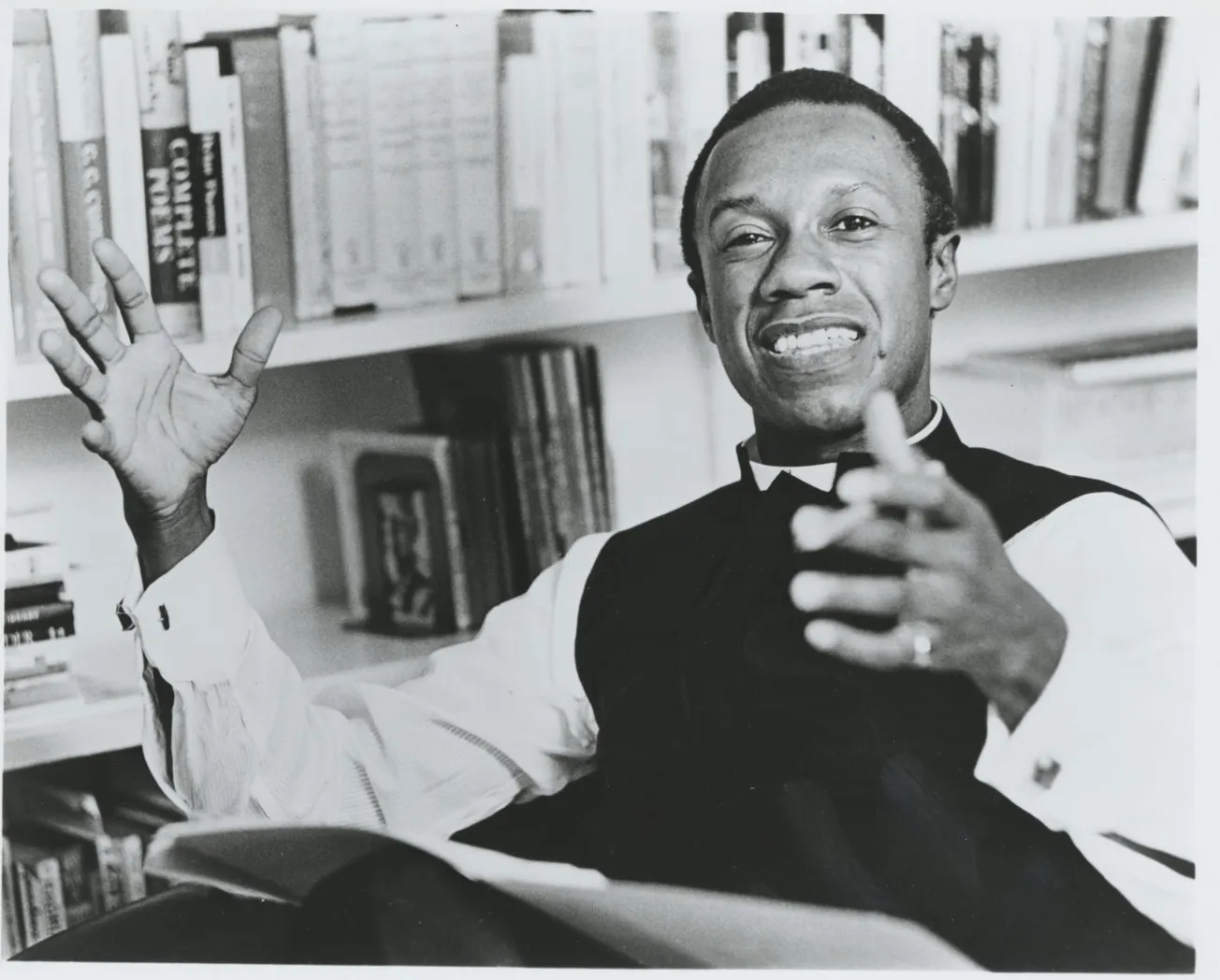
The late Fr Clarence Rivers, widely regarded as the father of Black Catholic liturgy, will soon receive a historical marker in his native Cincinnati, according to the local archdiocese’s Black Catholic ministry.
Dcn Royce Winters, head of the Office of African American Pastoral Ministries, announced the news on Dec. 1, roughly a year after first sharing that an application for the marker was accepted by a state historical commission.
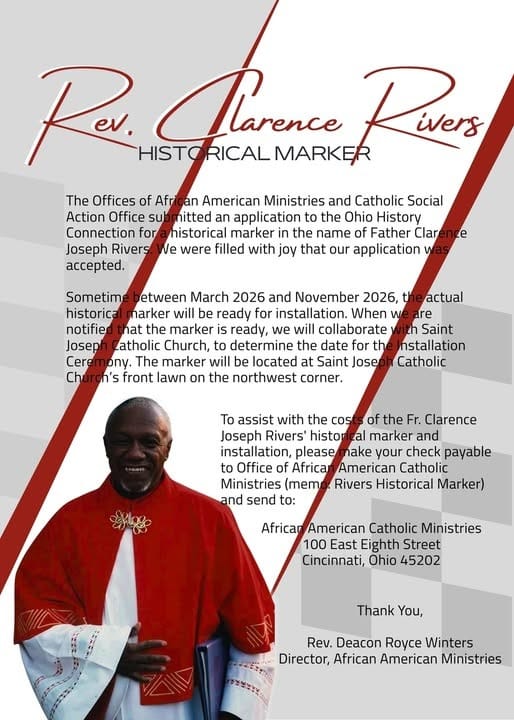
“Sometime between March 2026 and November 2026, the actual historical marker will be ready for installation,” Winters shared this month.
“When we are notified that the marker is ready, we will collaborate with Saint Joseph Catholic Church to determine the date for the installation ceremony.”
Born in Alabama in 1931, Rivers moved with his family to Cincinnati as a child and converted to Catholicism while attending St. Ann’s Colored School. He later entered the seminary, being ordained in 1956 as the Archdiocese of Cincinnati’s first Black priest. He went on to study at Xavier University, Yale, the Catholic University of America, and the Catholic University of Paris, obtaining a PhD from the Union Institute in 1978.
A watershed figure in the Catholic liturgical world, Rivers is known as the first Black Catholic liturgist to make use of African-American patrimony, having composed his “American Mass Program” in 1963 to widespread acclaim. Parts of it were used the next year at the first English-language Mass in America following the Second Vatican Council. Most notable was the hymn “God Is Love,” inspired in part by the musicality of Negro Spirituals.
Rivers’ insistence upon the authentic inculturation of Catholic liturgy broadly influenced the Black Catholic Movement, which began in the late 1960s and stretched through the remainder of the 20th century. During that time, his books “The Spirit in Worship” and “Soulfull Worship,” and his academic journal, “Freeing the Spirit,” promoted Afrocentric understandings of religion and philosophy, while he explored specific applications in a Catholic context, such as the Congolese “Missa Luba” from 1958—which Rivers taught to children at St. Joseph School in Cincinnati.
Rivers became the founding director of the National Office for Black Catholics’ Office of Culture and Worship in the early 1970s, going on to conduct workshops in Black Catholic communities around the country. He also collaborated ecumenically, including with the Hawkins Family on the 1971 album “Freeing the Spirit”, and in 1972 with the Morgan State College Concert Choir to record selections from his “Mass Dedicated To The Brotherhood Of Man.”
Rivers’ name is inscribed in the opening pages of the 1987 Black Catholic hymnal “Lead Me, Guide Me,” with the veteran priest described therein as having “revitalized Catholic worship, inaugurated a revolution in liturgical music, stirred international interest in the indigenization of Catholic liturgy, and brought new hope, joy, and spirit to millions of Black Americans when he introduced the melodies, rhythms, harmonies, symbols and rituals of African American Sacred Song into Roman Catholic worship.”
Rivers received the Berakah Award from the North American Academy of Liturgy in 2002. Modern efforts to promote Rivers’ memory have included a podcast series, “Meet Fathers Rivers,” hosted by Eric T. Styles and Emily K. Strand, as well as a 2024 symposium planned in part to honor Rivers’ contributions to African-American Catholicism.
The latter event marked the 20th anniversary of Rivers’ unexpected death in Cincinnati at the age of 73 in 2004, and included a blessing of the grounds for the upcoming historical marker, which will be located at Rivers’ former parish, St. Joseph Catholic Church in Cincinnati’s West End. Dcn Winters noted that tax-deductible donations to assist with the marker’s construction and installation can be made to the Office African American Pastoral Ministries.
Nate Tinner-Williams is co-founder and editor of Black Catholic Messenger.