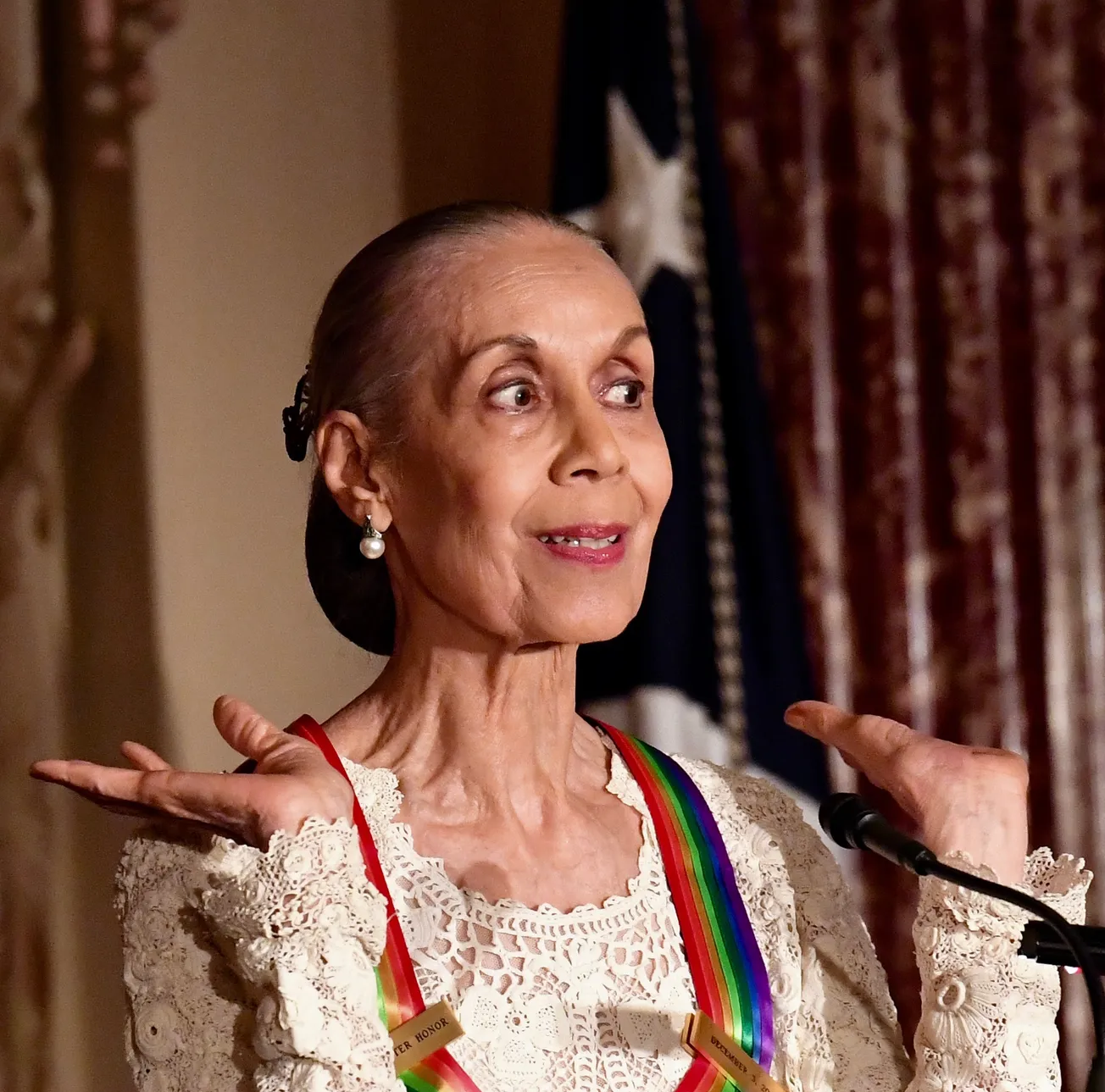
Carmen de Lavallade, an award-winning dancer, choreographer, and actress who broke racial barriers in various artistic fields, died in late December after a short illness. She was 94 years old.
Her family shared earlier this month their gratitude for tributes shared in honor of her legacy in recent weeks, calling her the “mother of all dances.”
“We are immensely grateful for the outpouring of love, kindness and celebration for the life and legacy of our matriarch,” they wrote on de Lavallade’s long-dormant social media accounts.
“Please continue to share your favorite photos and treasured memories. Thank you for your continued love, support and endless respect that you express to our family.”
Born in 1931 in Los Angeles, de Lavallade was the daughter of Black Catholic Creoles from New Orleans who had relocated to the West Coast during the Great Migration. After her mother’s death, she was raised by her father Leo and her aunt Adele de Lavallade Young. Carmen’s older cousin, Janet Collins, OblSB, would go on to become a star ballerina and foster Carmen’s budding interest in dance.
De Lavallade began studying ballet while in high school and joined Lester Horton’s notably interracial dance troupe at the age of 18, before moving to New York in 1954 to work with Alvin Ailey, her former high school classmate. She is credited with introducing Ailey to dance via their teacher Horton, leading to Ailey’s later prominence in the field.
Breaking into the acting scene in New York, de Lavallade made her broadway debut the year of her arrival and in 1956 became one of the first Black prima ballerinas at the Metropolitan Opera, succeeding her cousin Janet.
De Lavallade became a founding member of the Alvin Ailey American Dance Theater in 1958, and a string of engagements throughout the 1950s and 60s made her a household name in dance and theater. She also appeared in a number of films, including the Academy Award-nominated “Carmen Jones” in 1954 and “Lone Star” in 1996.
She joined the faculty of the Yale School of Drama in 1970, also working with the Yale Repertory Theater and teaching future stars of the likes of Meryl Streep and Sigourney Weaver. She was widely seen as a major figure in the breakthrough of African Americans into high art, despite the anti-Black racism of her day. (She notably refused roles that played into African-American stereotypes.)
In her later life, de Lavallade appeared with her husband and longtime collaborator Geoffrey Holder in the 2005 documentary “Carmen and Geoffrey,” which received rave reviews from critics. She also promoted dance opportunities for older artists, cofounding the PARADIGM dance collective in 1996 and commissioning new works. To cap off her career, she premiered a memoir-in-dance in 2014, “As I Remember It,” also to positive reviews.
De Lavallade was the recipient of various honors during her life, including two Bessie Awards (in 2000 for Sustained Achievement and in 2009-10 as part of the PARADIGM team), the Capezio Dance Award in 2007, and the Lifetime Achievement Award at the Obies in 2016. She was also awarded honorary doctorates from Purchase College in 2006 and the Juilliard School in 2008. In 2017, de Lavallade received the Kennedy Center Honors from President Donald Trump, but refused to attend the reception after his comments praising White supremacists at the deadly Unite the Right rally in Charlottesville, Virginia.
De Lavallade was predeceased by her husband of 59 years, Geoffrey Holder, who died in 2014. She is survived by her son, Léo Holder. No funeral details have been released.
Nate Tinner-Williams is co-founder and editor of Black Catholic Messenger.