As we rounded out Black History Month this year, the Center for Applied Research in the Apostolate felt it would be good to share some insights on the population of the Church that is celebrated during that month.
Data from the General Social Survey and the Cooperative Election Study in 2024 indicate the Black Catholic population has been quite stable over the past five decades at approximately 1% of the U.S. adult population. On average, in these national surveys, approximately 5% of adult Catholics in the United States self-identify their race as Black or African American. About 7.5% of Black or African Americans in the U.S. self-identify their religion as Catholic. 1% of the U.S. adult population self-identifying as Black and Catholic would represent about 2.8 million individuals in 2026.
Important to note is that the term “Black Catholic” here encompasses the whole diaspora of African and African-descended peoples in the United States—African Americans, African immigrants, Afro-Latinos, and Afro-Caribbeans. Black Catholics are far from monolithic in their cultural expressions and experiences of the faith and society.
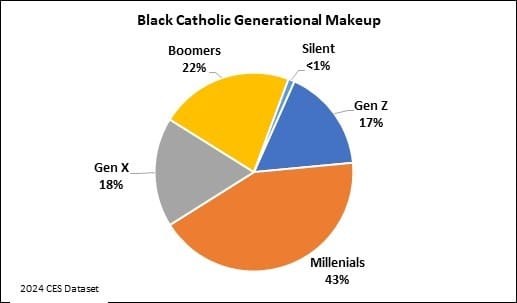
Within the Black Catholic population, 55% are men and 45% are women. The average age of Black Catholics is around 44 years old, and the median (middle-most) age is 40. The largest generational cohort of Black Catholics is the Millennials, making up 43% of the population. They are followed by the Boomers at 22%, Gen X at 18%, Gen Z at 17%, and the Silent Generation at less than 1%.
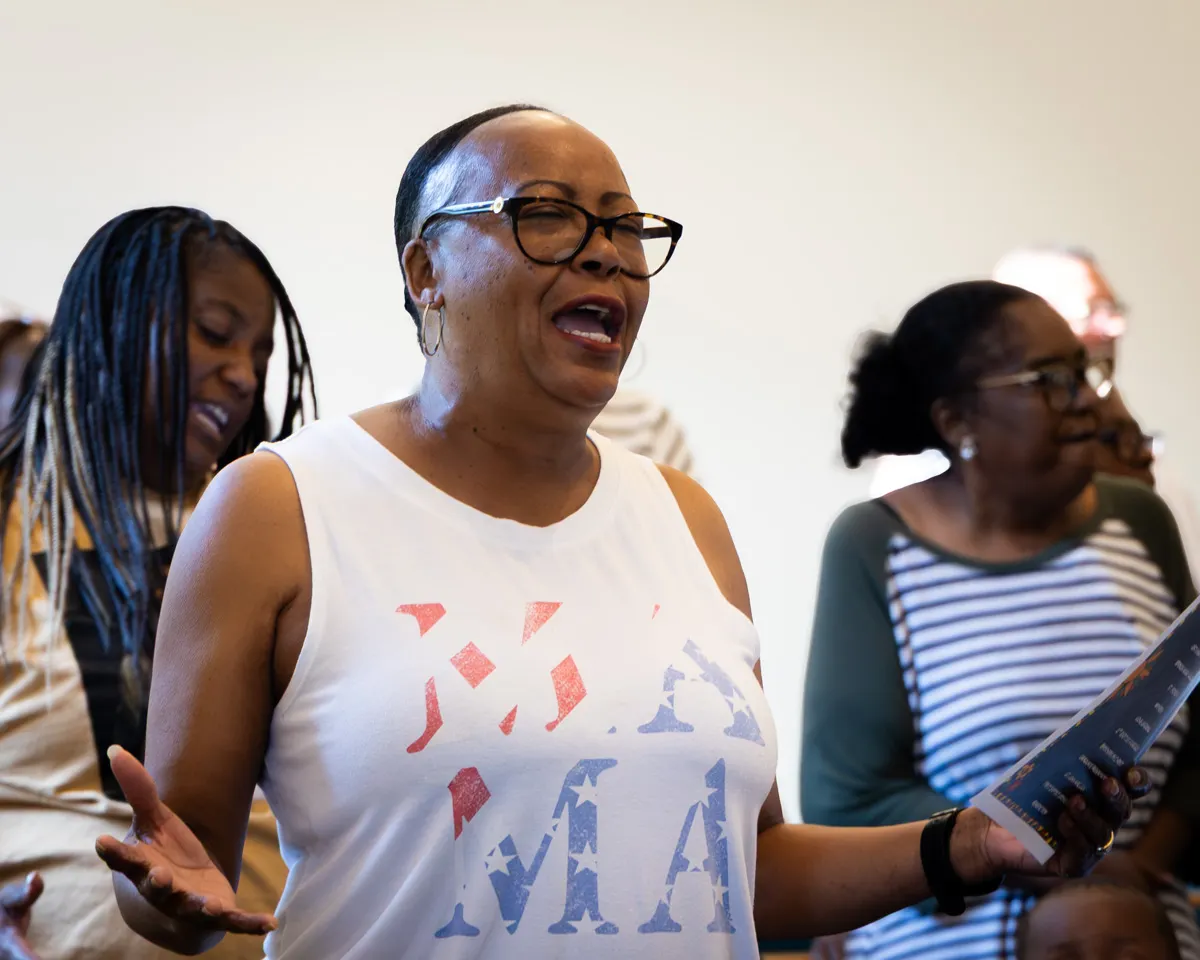
These statistics came as a surprise to this author. The youngest cohorts make up 60% of the Black Catholic population? As a Black Catholic young adult myself, when I go into Black Catholic spaces, I don’t see many Millennials or Zoomers. I see Boomers and Gen X. This begs the question: Where are the young people? And not in the perennial sense of the question about young people disaffiliating from religion—the data shows that in this case, they haven’t. Black Catholic young adults make up the largest portion of Black Catholics. Yet we often don’t see them. What does this mean? Sounds like an opportunity for research to me…
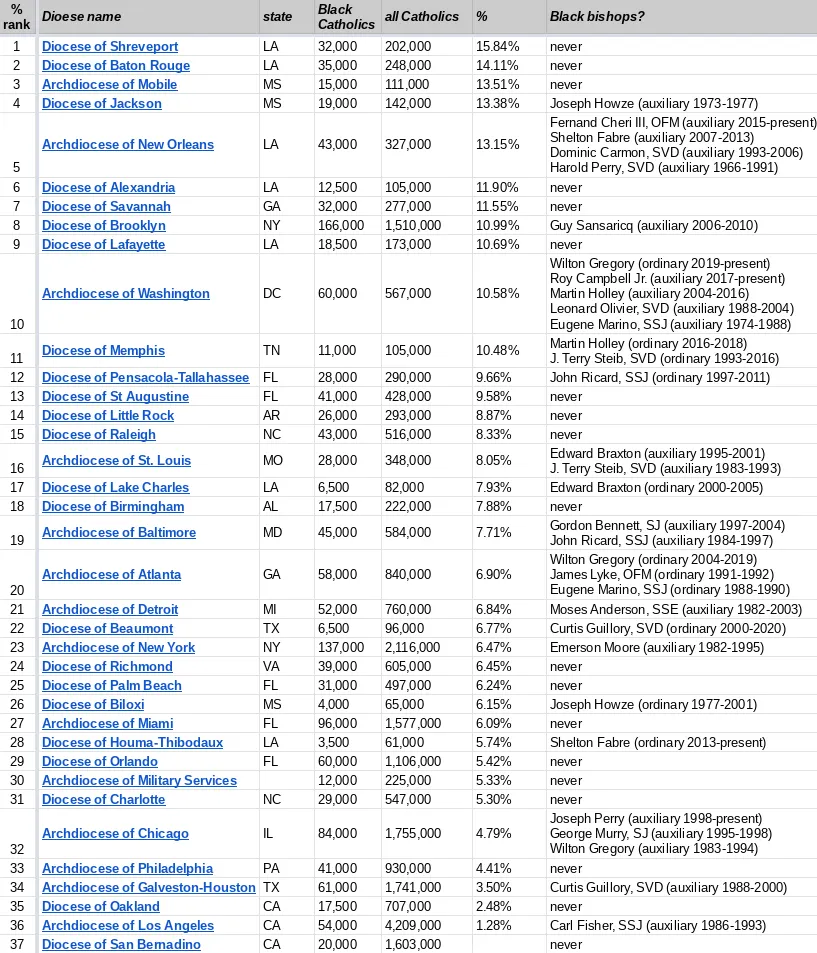
Black Catholics live predominantly in the South, with over half of the group residing in this region of the country (55%). Louisiana is known for having the highest number of Black Catholic churches. About one in five Black Catholics lives in the Northeast (21%). Slightly more than one in ten Black Catholics lives in the West (13%) or Midwest (11%). When considering political party affiliation, Black Catholics lean heavily Democrat with about three in five affiliating with the party (59%). Republicans make up 13% of the population, Independents are 22%, and 1% identify as Other.
Looking at religious behaviors of Black Catholics, we find that they have a higher Mass attendance than the overall Catholic population. 40% of Black Catholics attend Mass at least once a week or more, which is significantly more than the 26% of overall Catholics who attend Mass at that frequency. Additionally, over half of Black Catholics pray once a day or more (55%), whereas less than half of the overall Catholic population prays at the same frequency (47%). Black Catholics demonstrate a strong commitment to the faith they believe in, even as dioceses disproportionately close Black Catholic parishes and schools.
And as the 100th anniversary of Black History Month came to a close, I found some relevant questions to look at in the 2024 CES dataset that relate to race and racism. In fact, they touch on topics that an upcoming CARA national survey will also be exploring. In the CES survey, respondents were asked to what degree they agreed with the following seven statements, which are presented in the tables below. Respondents could rate “strongly agree,” “somewhat agree,” “neither agree nor disagree,” “somewhat disagree,” or “strongly disagree.” For the purposes of this analysis, “strongly agree” and “somewhat agree” were combined to create “agree,” while “strongly disagree” and “somewhat disagree” were combined to create “disagree.” Analysis was restricted to those who selected as their race “Black or African American” and “White.” This would include those who self-identified as non-Hispanic and White Hispanic. Below are the findings from the analysis.
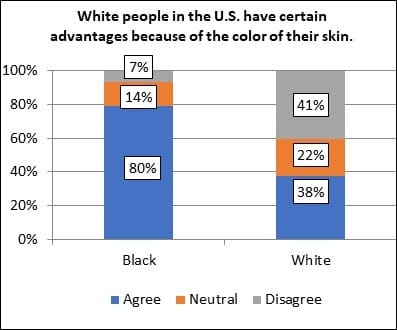
80% percent of Black Catholics agree that there are privileges that come with having White skin. White Catholics are less than half as likely as Black Catholics to agree with this statement (38%). White Catholics also are almost six times more likely than Black Catholics to disagree with the statement (41% compared to 7%).
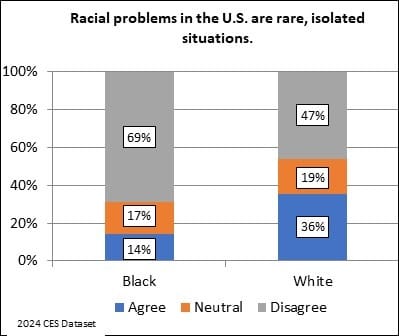
For the statement presented above, more than twice as many White Catholics (36%) agree as Black Catholics (14%). Additionally, there is a 22-point difference in disagreement on the statement between the two groups.
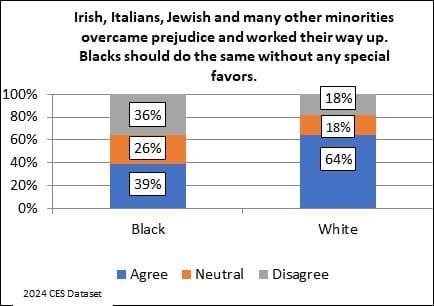
The figures below reveal additional differences in opinions between Black and White Catholics.
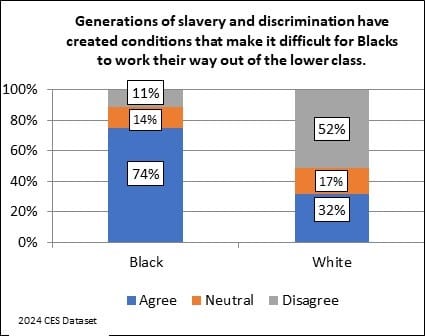
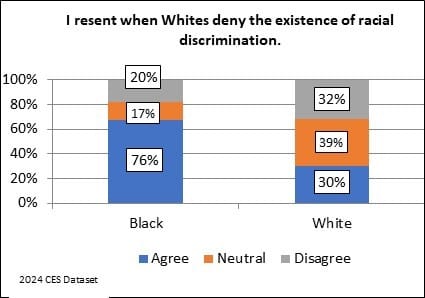
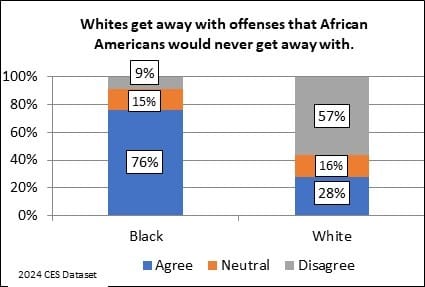
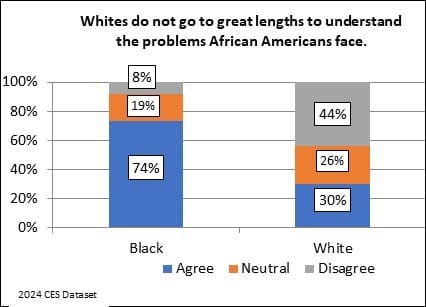
The findings of this analysis demonstrate that Black and White Catholics differ significantly on their beliefs about race and racism, and how these have played a role in the opportunities and experiences of African Americans. The goal of this post is not to create greater division within the Body of Christ, but rather to illuminate how wide the chasm is in acknowledgement and understanding.
The Catholic Church has a very definitive teaching on racism—that it is an evil and a sin. One can reference bishops’ letters such as “Open Wide Our Hearts,” “Brothers and Sisters to Us,” and manifold other resources to learn about Church teaching on racism. However, we can also look at the history of the treatment of Black people and Black Catholics in the U.S. Catholic Church and easily identify ways that the Church instituted and perpetuated this sin against its own members.
In this period of synodality and listening to the marginalized, these responses from Black Catholics are saying a lot. It is out of love and commitment to the gospel that the Church is responsible to listen.