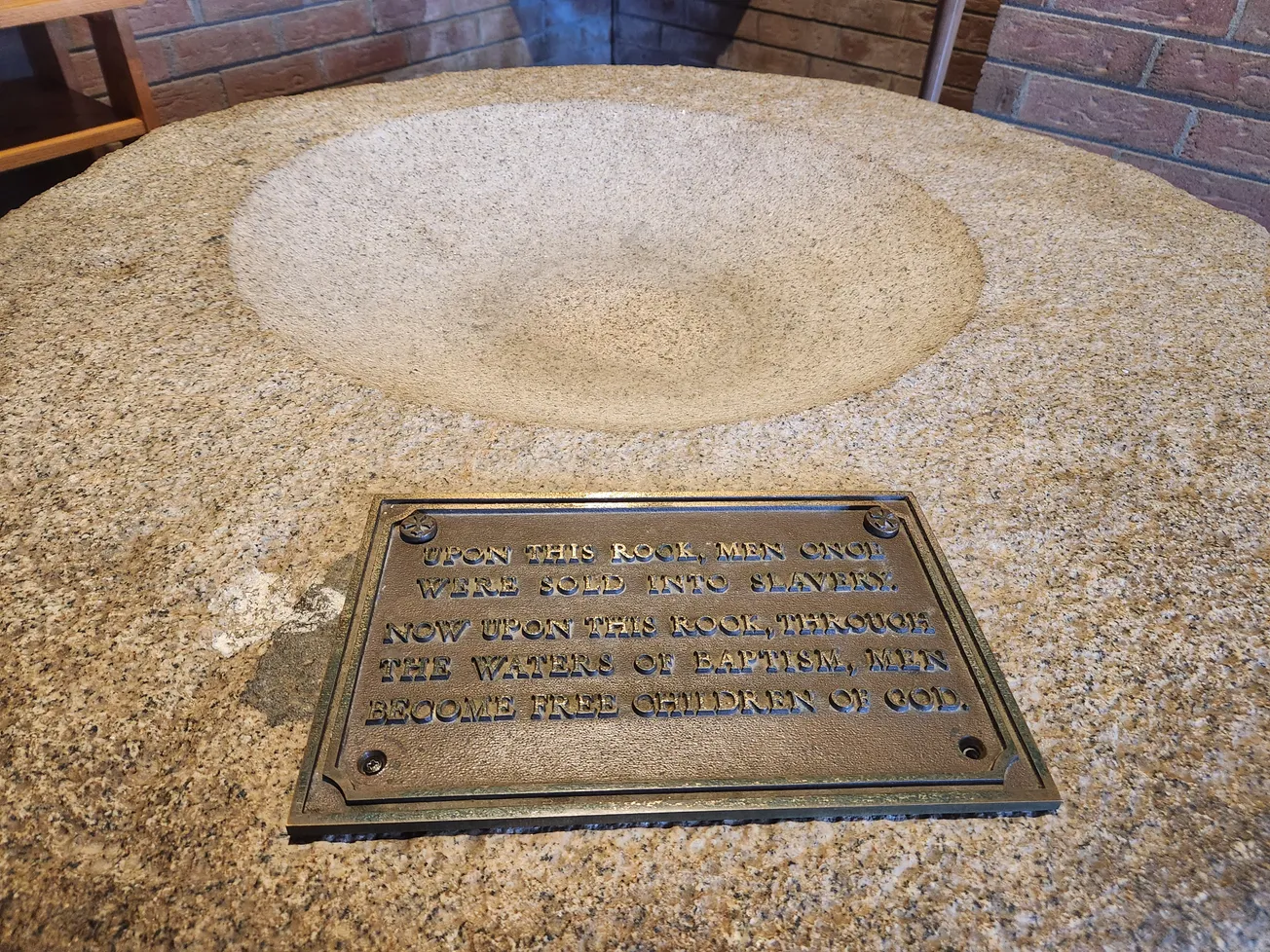
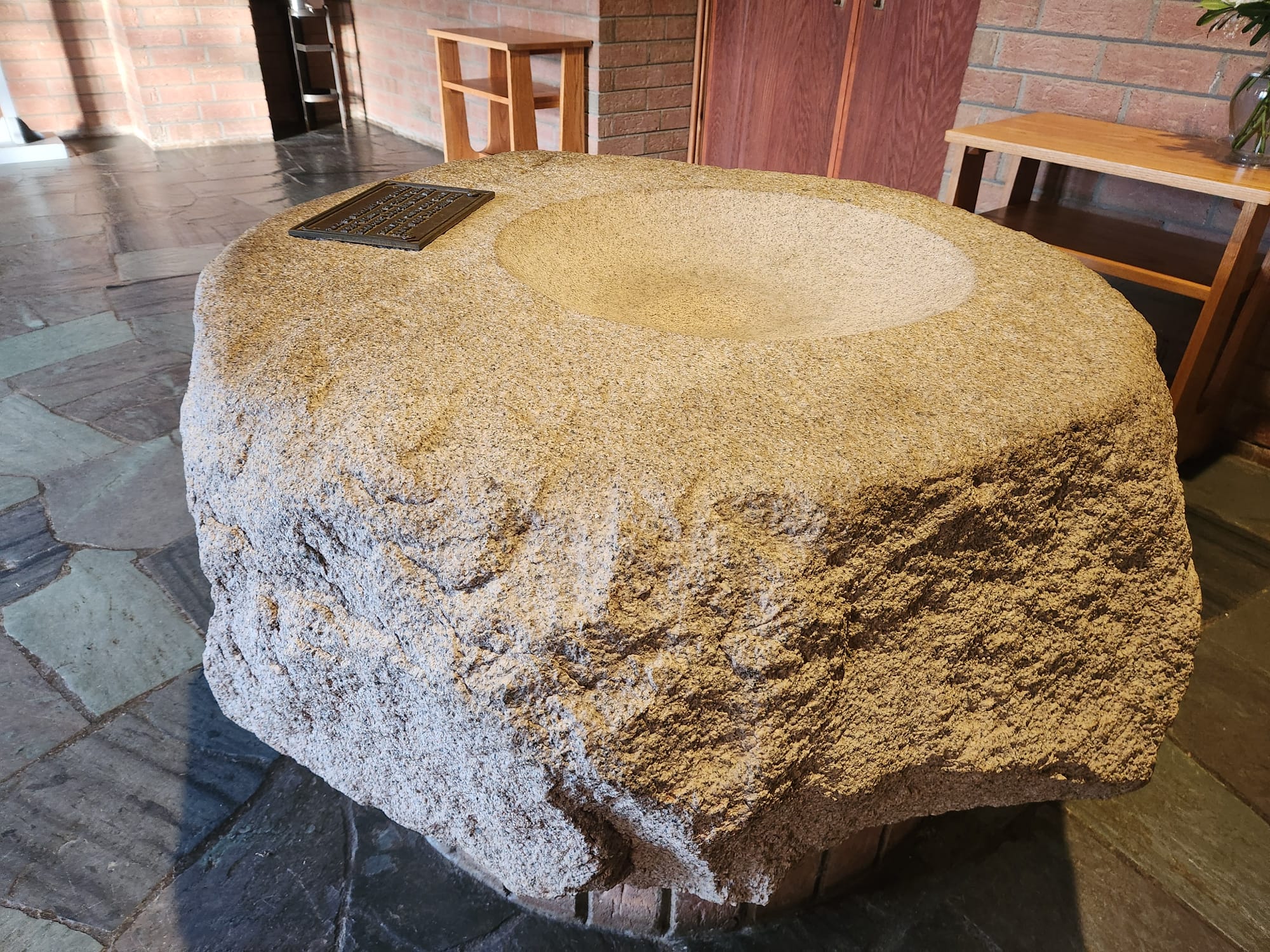
In the narthex of the Belmont Abbey Basilica in North Carolina, at the Benedictine monastery of the same name, sits a stone that holds the water of divine grace and purports to have borne the weight of human commerce. For decades, this reported former slave auction block—now a baptismal font—stood as a quiet symbol of Catholic redemption.
In February 2022, however, a social media post for Black History Month from Belmont Abbey College became an issue. The post featured a picture of the font and ignited a brief firestorm among students and alumni, proving that while the stone was carved into a new shape long ago, the wounds of its history remain raw and unresolved.
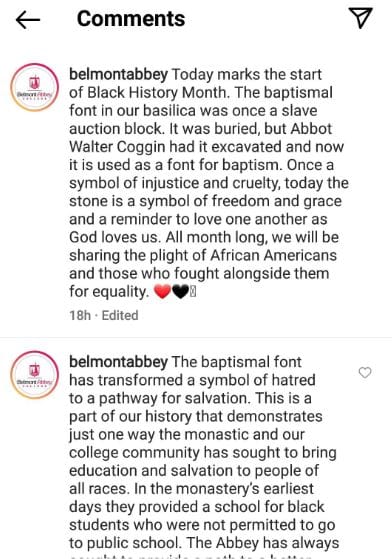
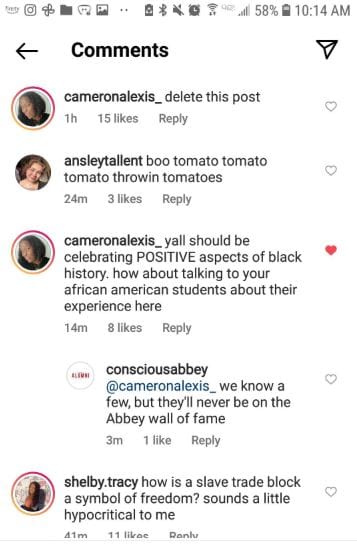
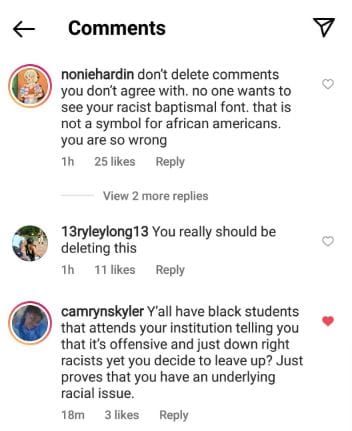

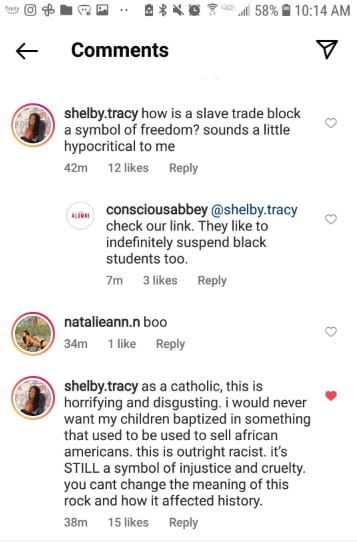
According to campus history, this stone served as a Native American altar and later as a slave auction block. However, some alumni have had questions about its true history and, at least, its context. Within hours of the BAC’s post in 2022, students demanded answers and a more comprehensive acknowledgment of Black history on campus. The college removed the post without providing any additional context.
This incident renewed a longstanding question at the small college near the North and South Carolina border: How should BAC address the intertwined narratives of race, faith, and belonging when one of its most prominent sacred objects is also associated with slavery?
Plantation land to a Catholic foothold
Belmont Abbey’s roots reach back to 1872, when the plantation era still scarred the land. The Catholic missionary Fr Jeremiah J. O’Connell purchased 500 acres in Gaston County that year, at a site known as the Caldwell Plantation, and later entrusted it to Benedictine monks in 1876.
In his book “My Lord of Belmont,” the late monk Fr Paschal Baumstein recounted O’Connell’s description of Gaston County in the late 19th century. The region had nearly 13,000 residents, with about a third of them Black. Yet only a small number of the African Americans identified as Catholics.
It’s safe to say that the monks depended on local help for maintaining their new outpost. During those early years, one monk observed that O’Connell “wisely recognized what poor farmers the monks were and gathered around him families of black sharecroppers and tenant farmers.”
Baumstein also recounted an attempt to admit a Black man, Br John, into the monastery, a decision that provoked protest from at least one White monk. John ultimately departed “for the sake of peace”—an early indication that anti-Blackness in the South would influence the abbey’s development.
Room in the pews
In 1893, Belmont’s abbot, Fr Leo Haid, appealed to a future saint, Mother Katharine Drexel from the Sisters of the Blessed Sacrament, for financial help to complete an abbey church. Drexel agreed to contribute $4,000—roughly about $144,000 in 2026—with a clear expectation: The new church must include pews for Black Catholics.
According to Baumstein, Haid embraced the idea, writing that if the Benedictines could “break down the ugly prejudices against Colored people,” it would strengthen the Church’s witness in the South.
“It would do my heart good to see some black faces there too — in the body of the church at that,” he wrote.
In the context of the Jim Crow South, observers viewed this condition as radical. It linked the abbey’s sacred architecture to an early, though incomplete, vision of integration.
Another abbey monk, Fr Melchior Reichert, had in 1885 opened a church, St. Benedict’s, on the abbey grounds for African Americans, whom he believed were uncomfortable in the company of Southern Whites, according to Baumstein. As part of Haid’s later deal with Drexel, the abbot turned the church into a dedicated school.
In any case, convenience may have given way to comfort for the local Black Catholics. In the mid-1910s, St. Helen’s Church was established for African Americans, with Belmont Abbey monks celebrating Sunday Masses. The church, some 14 miles from the monastery, remains one of four Black Catholic churches in the Diocese of Charlotte.
After the construction of the Belmont Abbey Basilica, the status of St. Benedict’s became unclear. Many BAC alumni from the 1960s and 1970s thought it had become a campus fraternity house that was moved off campus and destroyed by a fire in the 1990s. Even so, there are still memories. The St. Benedict Cemetery has been preserved off campus next to Interstate 85 and a Hampton Inn.
A stone transformed
As recounted in 2015 by a local reporter, a White BAC student collaborated with monks to uncover the “Mariastein” stone behind the monastery in 1964. It had previously served as part of a farm, had some origins to the indigenous people in the Catawba region and was acquired by the monks when they first arrived in Gaston County, after which they named it for the Virgin Mary. In the interim period, it had served as a slave auction block while owned by the Caldwell family.
BAC alumnus Ernie Miller, who helped rediscover the stone, said he learned it had caused the abbey’s early monks—who were unfamiliar to the predominantly White Baptist community in Belmont—to be perceived as slave worshippers. The stone also caused strain within the monastic community, leading to its burial in the woods near the monastery.
Miller, who died in 2019, was tasked by monks with locating and excavating the stone when he was a senior at BAC during the Civil Rights Movement. During its repurposing that year as a baptismal font, the monks carved a basin into the stone and placed it in the basilica’s narthex. A brass plate describes its transformation: from a rock upon which “men were once sold into slavery” to one upon which, “through the waters of Baptism, men become free children of God.”
It was potentially a powerful message. For others, though, it remains complex—or even troubling.
One alumnus, Thomas Gillespie from the class of 1976, said the stone-turned-font reshaped his understanding of faith and freedom.
“The slave rock (now a baptismal font) shaped my belief that through what had been a horrific era of slavery, that now through the waters of Baptism, Black men, women, and children would now become free children of God,” the Lowell pastor and city councilman said.
“It made me feel that the abbey recognized all mankind as free and equal children of God.”
He also connected the font’s symbolism to his own college experience.
“The symbol of the font let me know that I was truly free to love anyone that I chose to love,” he said, recalling a relationship that crossed cultural lines. “Love has no color.”
Decades after his graduation, Gillespie’s view of the stone has shifted from simple gratitude to a multifaceted warning.
“The font represents to me now that we cannot go back to a racist ideology,” he said.
“The baptismal font represents ‘freedom, equality, and love.’ It represents the very thing that White supremacy didn’t want people of color to have. Sorta like the crucifix, [which] now represents love and Christ. Born again!”
Protest and perseverance
The font notwithstanding, it goes without saying among Belmont locals that the college was a hotbed for the Civil Rights Movement in the 1960s. Five years after the font’s installation, in 1969, Black students occupied a campus building in a protest demanding Black professors and more books by Black authors in the library. After mediation, the college indefinitely suspended the students for a semester; only a few returned.
There were other notable moments in the 1960s and 1970s. The magazine Sepia featured then-monk Martin Boags in its April 1961 issue, as he briefly lived and worked as a novice in the monastery. BAC would later award an honorary degree to civil rights leader Septima Clark in 1978.
That said, representation at BAC has remained limited. In recent years, the school was ranked 56th among Catholic colleges for Black enrollment, which comprises only 11% of its student body.
Dr. Daniel Hutchinson, an alumnus who serves as BAC’s history department chair, sees the font as inseparable from the school's broader Black history. Hutchinson describes the abbey’s baptismal font as more than a decorative fixture. It is, he said, “a starting point.”
However, he suggests that symbolism alone has never been sufficient, and a deeper study of the stone may be needed. Reflecting on Black history at the college, Hutchinson spoke about what it means to have studied and now teach at an institution where Black students were often underrepresented, and how that reality shaped the campus climate during his time there.
The experience required resilience, he said, but it also deepened his understanding of faith and identity.
“You learn how to carry yourself,” Hutchinson said. “You learn that you’re part of something bigger, even when you don’t always see yourself reflected in it.”
He believes the modern conversations about BAC’s diversity and institutional memory strengthen the school rather than diminish it. He’s offered classes on local history and the Civil Rights Movement in response to student demand over the years.
“The faith teaches that every person has dignity,” he said. “Our history should reflect that.”
Finding belonging
For Wendy Morrow, who graduated in 1996, the font did not initially shape her sense of belonging.
“I first became aware of the baptismal font and its place in Abbey life when I arrived as a freshman,” she said, noting that she came from the Baptist and AME Zion traditions.
“The font did not immediately feel central to my experience or sense of belonging.”
While the Church teaches that baptism signifies equality, Morrow said that her “lived experience as a Black student sometimes reminded me that institutions do not always reflect that ideal in practice.”
Instead, Morrow said, she found a sense of belonging through athletics.
“Being part of the basketball team and building relationships with my teammates and other student-athletes created a community where I felt seen, supported, and included,” she said.
Angela Dreher also did not know the history of the baptismal font before enrolling at BAC. The Gastonia city councilwoman graduated from the school in 1987 and says she experienced the campus as welcoming.
“I would say that I found [BAC] to be inclusive, caring, and loving toward all students,” Dreher noted. “It is one of the places that I found acceptance based on academic ability and not my color.”
Dreher, a Baptist who attended services at the campus church on occasion, said the stone’s transformation carried spiritual weight and that “the resurrection of the stone in 1965 was symbolic of freedom for those who believe.”
“I always felt equal while at [BAC],” she added.
Looking back, Dreher sees the font as a layered artifact of North Carolina’s complicated past.
“I believe that the font represents a vast history of North Carolina, and starting with the Catawba Indians, then as a slave auction block to a baptismal font,” she said. “Representing diversity in its usage but eventually leading to the acceptance of God.”
Morrow, now an ordained Baptist minister, also interprets the font differently from the way she once did.
“Today, the baptismal font represents more than a religious tradition… It feels like a reflection point for [BAC]'s own growth,” she said.
As the college continues to confront its history, she believes the font can serve as “a reminder of the values the Church professes: unity, dignity, and belonging for all.”
An unfinished story
In 2026, the baptismal font still stands in the basilica narthex. Campus tour guides show it off. Students still pass it for daily Mass. Baptisms still take place with permission from the local parish, Queen of the Apostles Catholic Church. That church is less than a mile away.
When asked about the font’s role in 2026, a monastery official suggested the object “speaks for itself.” He also said the decision to place the font in the narthex predated his time at the monastery.
For some, the font remains a sacred sign of redemption. For others, it is a symbol that demands fuller storytelling.
Meanwhile, the school has made attempts to continue the conversation on racism and anti-Blackness. On June 20, 2020, then-BAC president Dr. William Thierfelder shared his thoughts on racism in light of the killings of George Floyd, Ahmaud Arbery, Breonna Taylor, and others in a now-removed college website post directed toward the BAC community. The college’s history department also hosted a symposium on Catholicism in the American South in 2024.
There’s always hope for more. Just last month, the school promoted new president Jeffery Talley’s social media post for Martin Luther King Jr. Day in a newsletter — a small gesture, but one welcome nevertheless.
After all, the history of Belmont Abbey College is inscribed not only in brick and stone, but also in collective memory. The challenge and opportunity is whether BAC will continue to present a comprehensive narrative, encompassing plantation land, segregated pews, student protests, and ongoing discussions about race.
In other words, while the water in the font may symbolize rebirth, the central question remains of whether the institution itself is prepared to embrace renewal.
Matt Memrick is a North Carolina-based journalist with 25 years of newspaper, TV and digital experience. A graduate of Belmont Abbey College, he currently works as a freelance writer for QCityMetro.com and writes about diversity issues with an unofficial alumni group called Conscious Alumni of BAC. His blog is at consciousalumniofbac.substack.com.