“We need to call him Jonah,” my wife groaned between contractions.
She had been in labor for over 30 hours, and I had joked that our son simply didn’t want to come out. He was acting just like the minor prophet who was stubborn and resisted the call of God, leading him to be in the belly of a great fish for three days.
When our son finally arrived three hours later, we didn’t name him Jonah. We actually named him after a different prophet: Moses and the great desert saint, Moses the Black. But the story of Jonah has always had a big impact on my life. Back when I was twenty, I remember wrestling deeply with whether Jonah was actually swallowed by a big fish. And if it’s just an allegory, does that pull the rug out from under my entire Catholic faith?
As I wrestled through that, I learned that, as Catholics, we believe the Bible is the Word of God, but we don't believe every passage has to be read as a literal historical account. The Church allows Catholics to understand Jonah as either a real event involving a miracle or as a story written to teach an important truth about God. So the question isn't simply, “Did this literally happen?” The more important question is, “What is God trying to reveal to us through the story of Jonah?”
Diving into the story of Jonah, we see that the Lord asks him to go to the Assyrian capital, Nineveh, and preach repentance to the wicked people who resided there. “But Jonah got up to flee to Tarshish from the presence of the Lord.” (Jonah 1:3)
As he sailed toward Tarshish, God sent a violent storm that threatened to destroy the ship. Jonah slept comfortably below deck while the terrified sailors cried out to their gods. They woke him up and cast lots, which fell on him. Jonah revealed to them that he was fleeing from the Lord and that they should throw him into the sea. So they did, and the storm ceased.
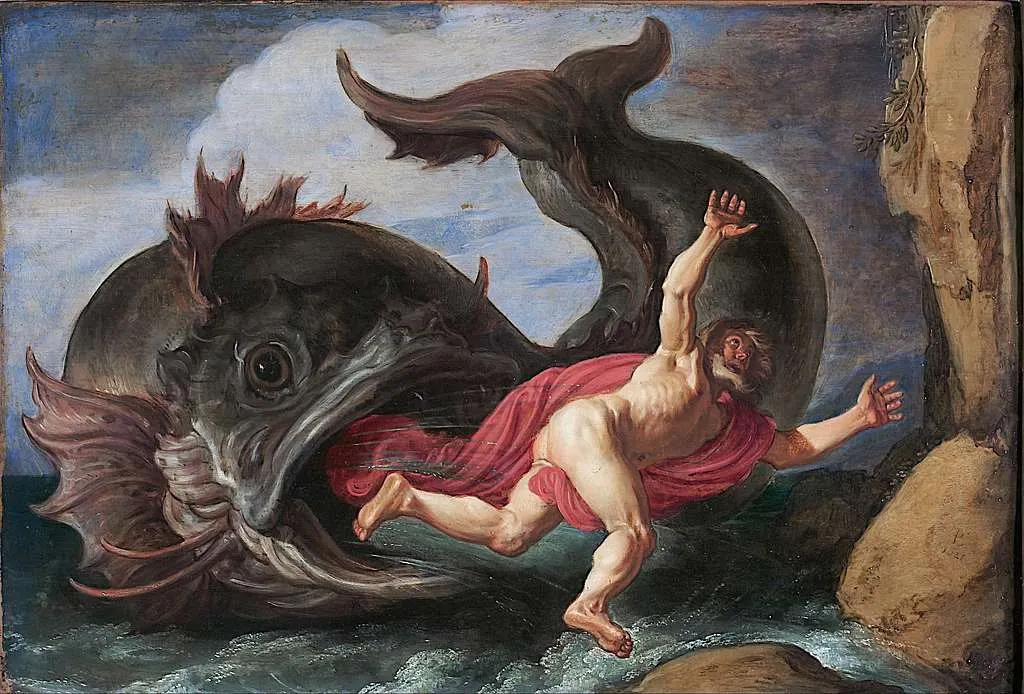
God sent a great fish to swallow the prophet, who remained in its belly for three days and three nights. In this way, Jonah prefigured Christ, who would lie in a tomb for three days. Jonah cried out to the Lord in prayer, and God heard him and commanded the fish to release him onto dry land.
Once again, God commanded Jonah to go to Nineveh. This time Jonah obeyed and entered the city, proclaiming that Nineveh would be destroyed if they didn’t repent. To his surprise, the people believed God’s warning and repented. When God saw their contrite repentance, He chose not to destroy them.
Jonah was furious. He never really wanted Nineveh to receive God’s mercy in the first place. He went outside the city and sat down, hoping to watch God smite them off the face of the earth. But the heat was intense, so God caused a plant to grow and cover his head from the sun. Jonah became content in the shade, but at dawn, God sent a worm to destroy the plant. This caused Jonah to grow angry at God for destroying the plant. Then God confronted Jonah with a question. If Jonah felt such concern for a plant he had not grown or tended, should God “not also have compassion on Nineveh, the great city in which there are more than 120,000 people, who do not know the difference between their right hand and their left.” (Jonah 4:11). The story ends there. Thus, the important part of the story isn’t that the fish swallowed Jonah. The real climax and point of reflection is Jonah's anger at God's mercy, for he did not want God’s mercy to extend to all of creation. He only wanted it to be given to select people and things (ie the plant and not Nineveh).
Years later, the prophet’s story resurfaced in my life in a completely different context. I was sitting at a baseball game with some donors for our inner-city youth ministry when tears began streaming down a middle-aged woman’s face.
“Did I not raise her right?” she wept. Her grown daughter had distanced herself from the family and completely fallen away from the Church.
I listened intently, doing my best to offer comfort to a mother I had only just met. This wasn’t the first time or last time a parent had poured out their heart to me about a child walking away from the faith they had so meticulously tried to instill in them.
So what is it? What is actually at the root of why so many people walk away from the Catholic Church? Is it poor catechesis? Is it spiritual hypocrisy, or a deep wound inflicted by someone in leadership? While those are undeniable factors, I would argue the biggest reason is simpler and far more interior: most people never develop a sustainable, intimate prayer life. Prayer cannot simply be reduced to a religious habit or custom. It must become a way of loving God and embracing what He loves.
And when we look closely at why people run today, their motives look remarkably like Jonah’s when he fled from the presence of God. We think everyone wants what God is offering, but they don’t.
Jonah was a prophet who knew the Lord and belonged to a people whose culture was deeply rooted in their relationship with God. Yet he chose to resist God’s desires, and even after obeying, he resented the mercy God showed the Ninevites. Jonah’s problem was not simply a lack of religious knowledge, but an unwillingness to love what God loved. He wanted God’s mercy for himself while resisting the same mercy for others. Perhaps this is where we need to look more closely when considering why people struggle to remain faithful. Knowing the teachings of the Church is not the same as allowing Christ to transform our heart. We can participate in religious activities and still resist the particular conversion God asks of us.
We must not turn to God only when we are in a pinch or when tragedy strikes. We must also pray for humility and the willpower to obey Him, especially when fear keeps us from doing what we know is right.
Let us pray,
Heavenly Father,
You are rich in mercy and compassion. You never cease to call Your children back to You, even when we flee from Your presence. Teach us to seek You in prayer, to surrender our will to Yours, and to rejoice in the mercy You extend to others. For those souls who have wandered from the faith, give us hearts filled with compassion, patience, and hope. May we never stop praying for their return, trusting that Your love reaches farther than we can imagine or hope.
We ask this through Christ our Lord.
Amen.
Bonus Joke: Blessed Fulton Sheen once gave a talk about Jonah in which he said after the lecture, a young person asked him if Jonah was actually swallowed by a big fish. Sheen replied, “I don’t know. I haven’t the slightest clue, but I suppose I will ask him when I see him in heaven.”
The young person replied, “What if he is not there?”
Sheen quickly quipped, “Well, you ask him then.”
Joseph Peach is a Catholic author, freelance writer, and speaker. He serves as the youth minister at St. Hilary Catholic Church in Fairlawn, Ohio, and has published seven books.