
As I slowly approached my eighth anniversary as a Catholic in March, I was overcome with the internal tension that has rocked and swayed my commitment to the faith for much of my time in the Church. I can’t ignore the internal conflict that shadows my journey—that the Church elevates the message of universality but continually leaves Black Catholics on the margins.
In 2020, I watched as EWTN, the world’s largest Catholic media network, attempted to silence Gloria Purvis, a Black Catholic radio host. The media powerhouse removed her from the “Morning Glory” show after seeing her bold commitment to racial justice in the wake of the murder of George Floyd.
When it came to ensuring the dignity of the Black family, worker, and community were protected in the monumental 2024 election, White Catholics overwhelmingly voted for a candidate bent on reversing Black progress.
I’ve also seen many White Catholics sanitize the discomforting history surrounding Black American Catholics up for sainthood. In addition, the canonization process itself features unfair obstacles for these holy figures, including institutional barriers and a general overlooking of their virtuous lives.
As it stands, the rebuttals to a sustained focus on Black Catholicism are predictable. One is the colorblind, post-racial axiom: “You can't subscribe to your race and still follow Christ.” Some have even attacked the intrusion of modernity into liturgical music. Leaders like the Guinean cardinal Robert Sarah insist that liturgical music must be influenced by tradition rather than contemporary culture. While this may seem like an impassioned defense of Church authority, stances like these serve to devalue the worship and expression of many Black Catholics.
These passionate attacks, cold indifference, and institutional roadblocks prompt for me a central question: What makes Black Catholicism and the needs of Black Catholics so threatening to many White Christians?
The tension also makes me question why I remain a believer in the Catholic Church even when it fails to incorporate Black Catholics into the fullness of the Christian mysteries. After all, White Supremacy operates by cloaking itself in Christian themes, language, and teachings. Moreover, it was the American Judeo-Christian foundation that helped birth the nation’s racial caste system. By establishing systematic policies that excluded Black Americans from the opportunity to participate in religious life, White Catholics created barriers to inclusion in the Body of Christ.
In the U.S. Catholic Church, Black believers have experienced strong censure from an institution that may welcome Black people in the door, but not with their culture, spiritual gifts, and leadership. When I entered the Church, I trusted in the assurance that the true Catholic faith is capable of baptizing every culture and language into the sacred mysteries of Christ. Yet the Church’s failure to live out this rich theology has wrongly suggested that Black identity is incompatible with God—a misconception that undermines the Church's claim of universality.
The chasm between theology and application is increasingly difficult to ignore. While the Church in America has made statements, pastoral letters, and diverse appointments of Black clergy to rectify their involvement with the sin of racism, these steps have often appeared more performative than transformative. Anti-Blackness, racism, disinvestment, and disenfranchisement have consistently increased over the decades, not because the Church doesn’t have the right words, but because it lacks the commitment. Shallow promises without resolve do little to heal the wounds that have been generationally transferred.
These long-lasting wounds continually challenge my faith and demonstrate persistent separation from opportunities for Black Catholics. One example I always come back to is the inequality of vocational opportunities. Very early in my Catholic conversion process, I attended an affluent parish in the Archdiocese of Galveston-Houston and saw a wide array of vocational resources and opportunities that could be a seed planted for discerning priestly vocations.
On the other hand, when I attended a Catholic parish with a strong Black presence, I saw a distressing lack of support and willingness to engage Black Catholic children to nurture a vocation. The vocational promotion and infrastructure paled in comparison to what I had seen in the well-resourced White Catholic community. With such drastic disparities in resources, the Church advances an unequal system that overlooks Black Catholic communities while affluent White parishes obtain the materials needed to make vocations a possibility.
This type of restrained support is contradictory to the U.S. bishops’ own stated commitment to justice at the parish level. In “Open Wide Our Hearts: The Enduring Call to Love,” the bishops share what making action at the parish level looks like:
"Within our dioceses, taking concrete action means ensuring that struggling parishes, schools, and organizations receive resources and training for catechesis, youth ministry, and other pastoral needs. It also involves providing necessary support to families, seniors, and ex-offenders”
For centuries, Black Catholic men in America were prohibited from entering seminary due to racism, and the failure to raise Black Americans to sacred orders still persists. It's a distressing reality: The dignity and worth of some in the body of Christ are recognized while that of others are disregarded. The Church and its institutions have no shortage of powerful policies, but too often the words fail to translate into meaningful structural change.
Because of issues such as this, I—like many Black Catholics—have turned inward toward ancestry, lineage, and cultural pride to cement my faith. We can look, for example, at the Black Catholic Movement to find empowerment to decolonize Catholicism so that it affirms our Black identity.
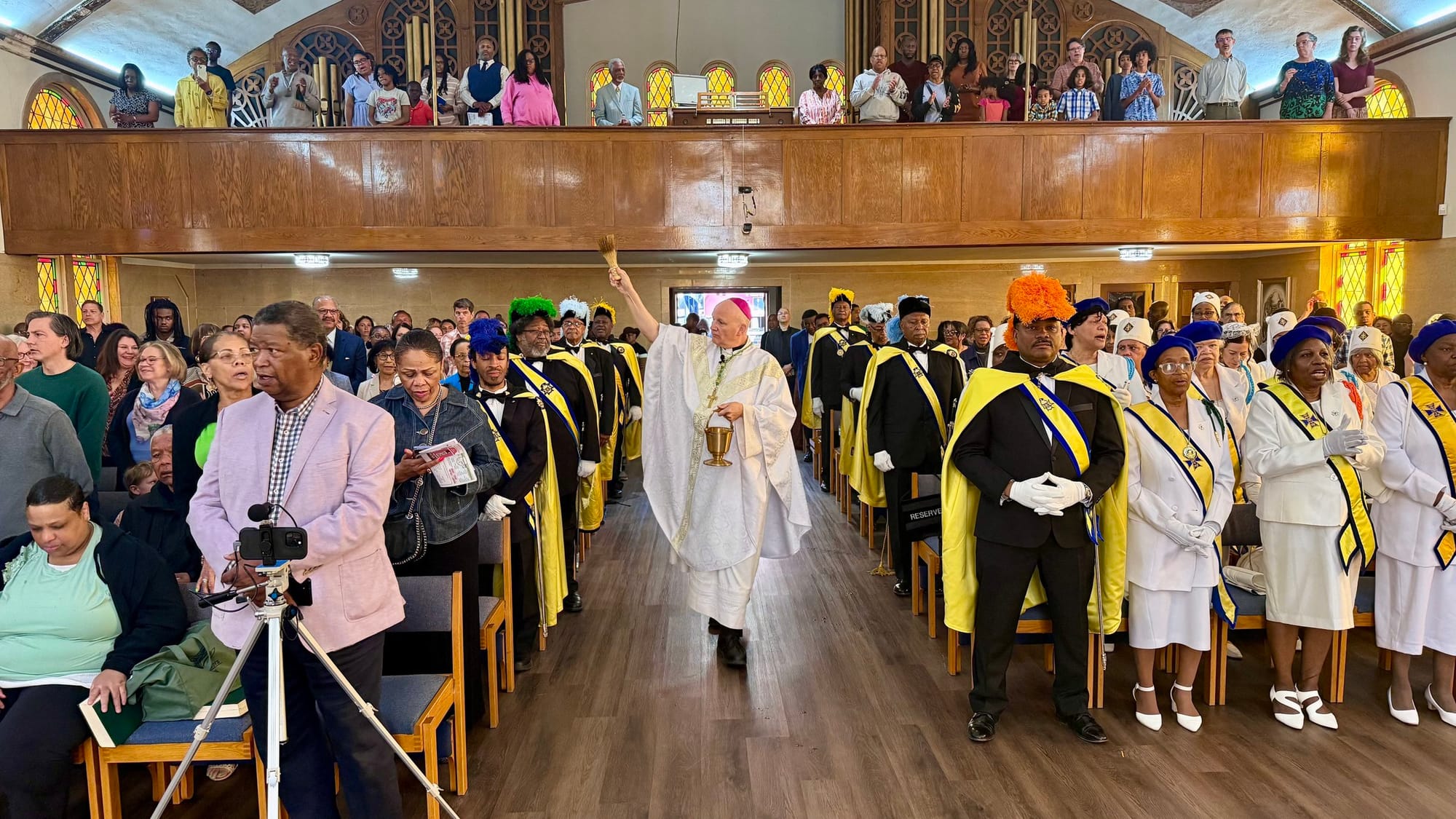
The history of Black Catholicism, which is inseparable from Black history in the United States, is that we persisted and struggled against structures and forces that meant us harm. Our passion for progress and pathways to showcase our gifts, imagination, and leadership were transfigured into God’s glory. In this illustrious story, Blackness is not an impediment but rather an imprint of the image of God on those moving toward a promised land of emancipation.
In this journey toward Black pride, I occasionally revisit portions of “The History of Black Catholics in the United States” by Fr Cyprian Davis, OSB. In this crucial work of scholarship, I see how my ancestors strived to remain Catholic in spite of structural forces that sought to destroy their fellowship and dignity. In this increasingly hostile and unwelcoming home, I find that I teeter on whether my racial identity is truly compatible with the faith I converted to. I am filled with hope because I know my ancestors didn’t take refuge in White Christianity as a means of preservation; instead, they formed a distinct expression interwoven with the Black Catholic witness, with courage to trust that freedom, whether within or outside the Church, belonged to them.
While the historicity of the Catholic Church and its coherent continuity of doctrine were undeniable facts that converted my heart, in the last 6 years it’s been the seven Black American Catholics on the pathway to sainthood and others of the diaspora who have motivated me to continue being a Catholic.
I’m reminded of Servant of God Thea Bowman and her powerful legacy and ministry as an unapologetically Afrocentric model of boldness in a time when championing Black identity was still an emerging idea across the country. Her powerful address to the U.S. Catholic bishops in 1989, even while she was stricken with cancer, conveyed her awesome ability to forge a pathway for Black Catholics.
Likewise, I’m reminded of the brilliance of someone I hope will one day be canonized as a saint, Fr Clarence Rivers. He demanded that the inculturation of the liturgy include Black expression. From developing awe-inspiring liturgy and advocating for Black sacred song and worship, Rivers tore down a dividing wall that dominated for so long in the Catholic Mass.
The witness of Bowman, Rivers, and others reminds me that the fullness of the Catholic faith doesn't erase what it means to be Black. Instead, it is an illumination that reveals the sacred gifts of Black culture, talent, and spirituality that glorify and are valuable to the Creator.
For me, these pioneers of the Black Catholic Movement embody the unrealized vision of Daniel Rudd, a 19th-century Black Catholic advocate and journalist. He once declared that “the Catholic Church alone can break the color line. Our people should help her to do it.”
In their marvelous works of infused grace and fervor for the holy spirit, the seven Black Catholic candidates for sainthood and others of the diaspora showcase that the Creator’s unfailing love includes Black people in the divine plan.
If the White dissenters who create stumbling blocks were committed to truly being prophets against racial injustice, where is the fruit that demonstrates their commitment, their solidarity with the Black community, and their work for an inclusive Church? The optimist in me hopes that many will become better anti-racists, but the realist, who understands the history of the Catholic Church, is skeptical and even doubtful.
For now, I remain Catholic, but being Black is a permanent marker, and everything that I do needs to be centered around this truth, as it precedes my faith. Before I became a Protestant or entered the sacramental life of the Catholic Church, I was Black. I grew up extremely aware of how my Blackness shaped the way the world saw me and treated me.
Being born to a Ghanaian father and Black American mother—who equally knew the importance of heritage, lineage, and history—I grew up with an appreciation for Kwame Nkrumah and Dr. Martin Luther King Jr. as Black leaders for self-determination and justice. With this rich foundation, my Black identity was seen as an inherent part of my being that faith was eventually added to. I remain thankful to teachers, ministers and theologians such as Revs. Richard Allen, Absalom Jones, Dr. James Cone, Fr Cyprian, and Albert Cleage, whose leadership, ministry, and scholarship helped forge a deeper understanding of Blackness as sacred, calling me to see myself in God’s glory.
As I reflect on what needs to happen to reassure my faith, I observe that the invaluable lessons I learned on racial pride and empowerment from my childhood home and my intellectual mentors are being carried by young adult Black Catholics, giving me immense hope. These true prophets for justice are raising awareness of the many concerns present in the U.S. Catholic Church, and in doing so, are dismantling barriers that impede belonging and reconciliation for Black believers. Their work and willingness to meet Church leaders directly address many of my frustrations about being a Catholic.
In 2025, a group of impassioned Black Catholic young adults participated in listening sessions sponsored by the U.S. bishops’ Subcommittee on African American Affairs to gather input on the needs of their community. The results of their findings were published in a report that highlighted a wide array of issues with the Church.
One of the most pressing issues highlighted was the problem of failing to speak about White Supremacy and racism. Participants underscored that historically marginalized people feel unseen in the Church because difficult issues are often unaddressed in order to shield White Catholics' from confronting uncomfortable truths about racism.
Moreover, the group of young adults highlighted that clinging to a Eurocentric model of tradition that prevents better ideas is a pervasive barrier to progress in the Church. The group recommended a renewed focus on the core teachings of Jesus instead of inherited, long-standing White Christian hegemony. By doing so, they said, the U.S. Catholic Church will more effectively reach people across different cultures, including Black Americans.
These recommendations, if implemented, would be a step in the right direction to calm the troubled waters that I have had to navigate in the ark of the Church. They offer a vision of transferred institutional power—historically held by White Catholics—and put forward a better method of communicating the Gospel.
In various Black American religious traditions, which most likely can be traced back to Africa, there is a belief in the communion of saints, akin to the understanding in the Catholic Church. Growing up, it was customary for me to hear and see veneration of the ancestors, the honoring of relics, and the invocation of the departed.
When I became Catholic, this practice wasn’t foreign to me; even so, this powerful teaching is what grounds me. Those who modeled well how to embody spiritual stewardship and love of neighbor keep me sustained on my journey over the tumultuous tides and daunting waves beneath the Christian ark.
As I still navigate, I pray that the intercession of all African-descent holy men, women, and children guide me to justice, the embrace of my heritage, and the tireless work for a Church that truly affirms Black people.
Efran Menny is a husband, father, and regular contributor to BCM. His work is informed by his experience as an educator and his studies in social work. He has a passion for elevating topics on justice and theology for Black Catholics.